
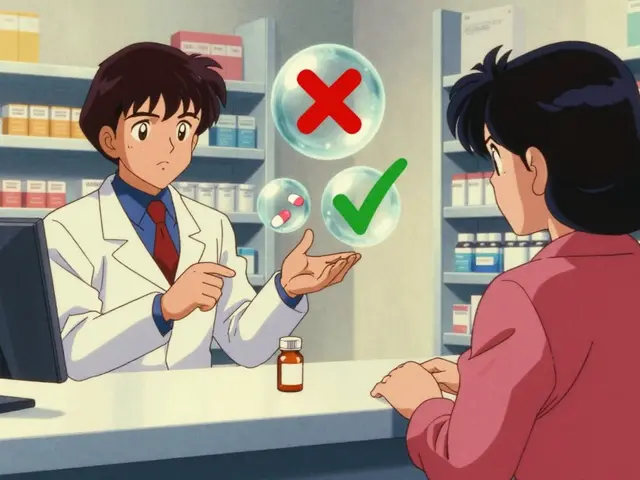
When a pharmacist sees a brand-name prescription, they don’t just fill it. They look at the generic drug substitution option-and if it’s safe, effective, and cheaper, they reach out to the prescriber. This isn’t just about saving money. It’s about getting patients the right medicine at the right price, and doing it right requires clear, evidence-based communication.
Why Pharmacists Even Bother Talking to Prescribers
Most people think pharmacists just hand out pills. But their role goes way beyond that. In the U.S., 97% of prescriptions filled are for generic drugs. That’s over $409 billion saved every year. But here’s the catch: not every generic can be swapped automatically. Some medications need a conversation. Take warfarin, levothyroxine, or phenytoin. These are narrow therapeutic index (NTI) drugs. A tiny difference in dose-or even in inactive ingredients-can throw a patient off balance. That’s why pharmacists don’t just swap them out without checking. They call the doctor. They say: “This patient’s on brand X. The generic version is bioequivalent, but here’s what I found in the FDA’s Orange Book. Can we switch?” It’s not about pushing generics. It’s about making sure the switch won’t hurt. And the data backs this up. A 2018 study of 12.7 million patients showed that switching to generics improved medication adherence by 12.4%. That means fewer missed doses, fewer hospital visits, and better outcomes.The FDA Orange Book: The Pharmacist’s Bible
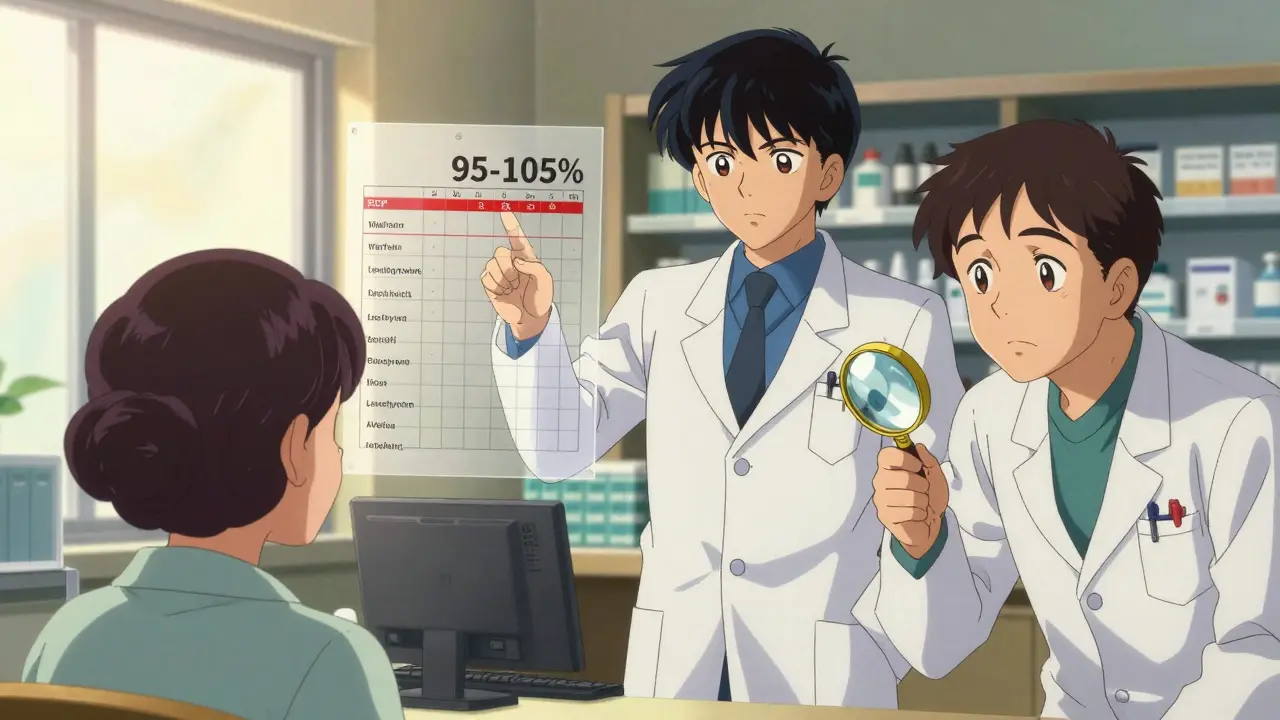
The FDA Orange Book is the go-to source for determining if a generic is truly equivalent to the brand. It lists every approved drug and gives it a rating: “A” means therapeutically equivalent. “B” means it’s not. As of 2023, over 92% of generics carry an “A” rating. Pharmacists don’t guess. They open the Orange Book. They check the active moiety. They match the NDC code. Then they compare the manufacturer’s bioequivalence data. The FDA requires generics to show that their drug’s absorption rate (AUC) and peak concentration (Cmax) fall within 80-125% of the brand. In reality, 98.7% of approved generics land between 95-105%. That’s tighter than most people think. When a pharmacist talks to a prescriber, they don’t say, “It’s just a generic.” They say: “The generic from Teva has an A rating. Its AUC ratio was 99.2% with a 95% CI of 97.1-101.4%. That’s within the FDA’s bioequivalence range.” That kind of detail changes minds.When You Can’t Substitute-And Why
Not every prescription can be switched. About 15.3% of all prescriptions have “dispense as written” (DAW) on them. That’s the prescriber saying: “No substitutions.” Why? Sometimes it’s because the patient had a bad reaction to a different brand before. Sometimes it’s because the drug has tricky delivery-like an inhaler or a topical cream. A 2023 survey found that 42.3% of prescribers worry about generic inhalers. Why? Because the inactive ingredients affect how the drug is delivered to the lungs. Same active ingredient. Different pump mechanism. Different result. Then there’s allergies. About 8.7% of substitution issues come from inactive ingredients. One patient might be allergic to the dye in a generic tablet. Another might react to the filler in a capsule. The A-SMEDS guide from 2023 says pharmacists need to check excipients before swapping. That means looking up the manufacturer’s ingredient list-not just assuming all generics are the same.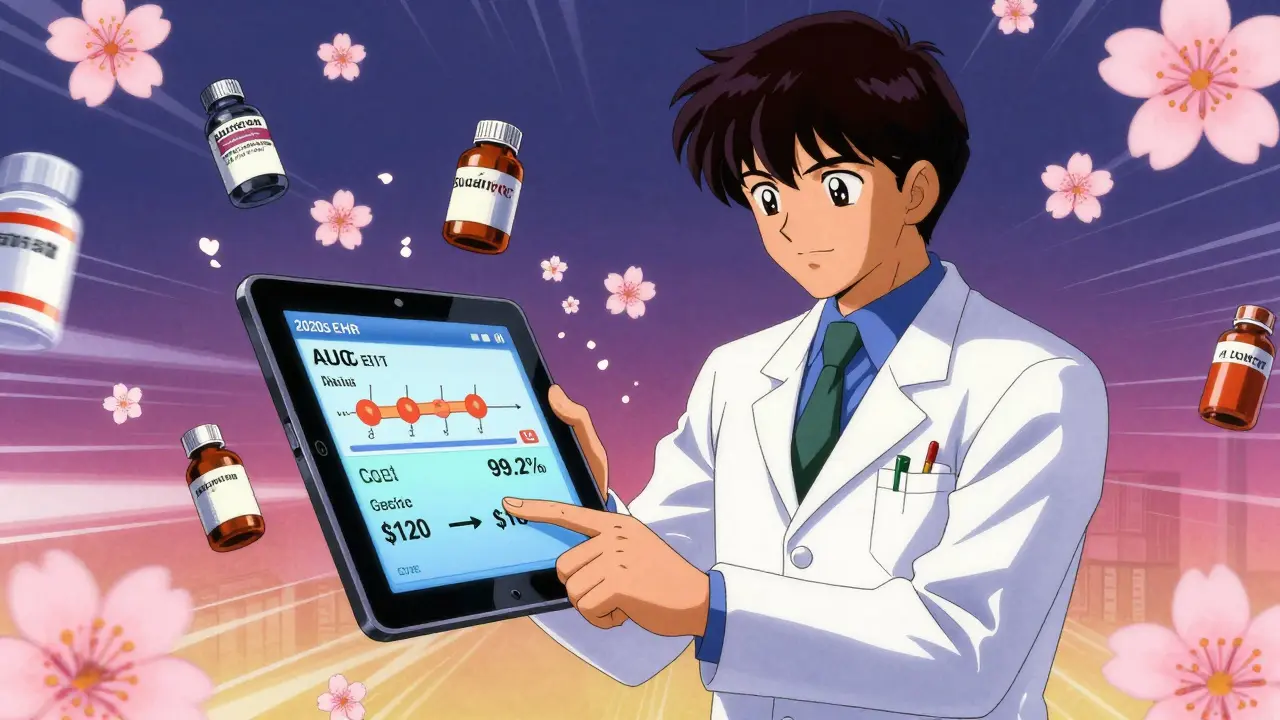
How to Talk to a Prescriber-The Right Way
A 2021 study in the Journal of the American Pharmacists Association found that pharmacists who used a structured approach got 82.4% of their generic recommendations accepted. Those who just said, “Can I substitute?”? Only 57.3%. Here’s what works:- Call or send a secure message within 24 hours of receiving the script.
- Reference the FDA Orange Book rating-don’t just say “it’s generic.”
- Include the cost difference. Example: “Brand X is $120. Generic Y is $18. Same active ingredient. Same A rating.”
- Offer to send the bioequivalence data if they want it.
- Document everything in the patient’s record.
What’s Holding Pharmacists Back
It’s not all smooth sailing. A 2023 survey found that 41.7% of pharmacists aren’t confident discussing complex generics-like extended-release tablets or transdermal patches. They know the theory, but they don’t have the data at their fingertips. Prescribers are hesitant too. Nearly 60% say they worry about therapeutic equivalence. Over 62% say they don’t have time to review substitution requests. That’s where pharmacists need to be concise. The best approach? Don’t write a novel. Send a quick message with three key points:- Generic name and manufacturer
- FDA Orange Book rating
- Cost savings
State Laws and the Patchwork of Rules
This isn’t a national system. It’s 50 different state laws. Forty-nine states let pharmacists substitute generics unless the prescriber says “do not substitute.” But 17 of those states also require the patient to give consent-written or verbal. Five states (Connecticut, Massachusetts, New York, Texas, Virginia) only allow substitution from a pre-approved list of generics. That’s called a positive formulary. It affects nearly 1 in 5 Americans. And documentation? Required everywhere. CMS audits show that pharmacies using electronic systems hit 98.7% compliance. Paper records? Only 76.4%. That’s a big gap-and it’s why more pharmacies are moving to integrated EHR systems.What’s Changing in 2025 and Beyond
The Inflation Reduction Act, effective January 2025, expands pharmacists’ role in Medicare Part D. More patients will get medication therapy management (MTM) services. That means more chances for pharmacists to recommend generics-and more time to talk to prescribers. AI tools are stepping in too. PharmAI’s Generic Substitution Assistant, now used by nearly 30% of chain pharmacies, analyzes prescriptions and suggests the best generic based on bioequivalence data, patient history, and cost. It cuts communication time by 42% and boosts accuracy from 76% to 94%. The FDA is also updating the Orange Book platform in 2024 to include real-world data-like how generics perform in actual clinics, not just labs. And the CDC is launching a Generic Medication Safety Network in late 2024 to flag any safety signals between brand and generic versions in near real-time.It’s Not About Saving Money. It’s About Better Care.
Pharmacists aren’t trying to replace brands. They’re trying to make sure patients get the same medicine at a price they can afford. And when they communicate clearly-with data, with respect, and with urgency-they get results. A 2023 study of 4,521 pharmacies found that those using standardized communication protocols had 27.5% fewer medication errors and 18.3% higher patient satisfaction. That’s not just good business. That’s better care. The next time you see a pharmacist reach out to a doctor about a generic, don’t think they’re being pushy. Think: they’re the one who noticed the difference-and they’re making sure it’s the right one.Can pharmacists substitute generics without asking the doctor?
In 49 states, pharmacists can substitute a generic if the prescription doesn’t say "dispense as written" or "do not substitute." But even then, they must follow state rules-some require patient consent, others limit substitutions to specific brands. For narrow therapeutic index drugs like warfarin or levothyroxine, pharmacists typically call the prescriber first, even if not legally required.
Are generic drugs really as effective as brand-name drugs?
Yes. The FDA requires generics to prove they deliver the same active ingredient at the same rate and extent as the brand. Bioequivalence testing must show the generic’s absorption falls within 80-125% of the brand. In practice, 98.7% of approved generics fall within 95-105%, meaning they perform almost identically. Studies show no difference in clinical outcomes for most conditions.
Why do some doctors refuse generic substitutions?
Some doctors worry about inactive ingredients causing allergic reactions or affecting drug delivery-especially with inhalers, creams, or extended-release tablets. Others have had patients report feeling different after switching, even if clinical data shows no difference. A 2023 survey found that 58% of prescribers cite therapeutic equivalence concerns, and 62% say they don’t have time to review substitution requests.
How do pharmacists prove a generic is safe to substitute?
They use the FDA’s Orange Book to confirm the generic has an "A" rating for therapeutic equivalence. They check the manufacturer’s bioequivalence data, compare active and inactive ingredients, and consult Product-Specific Guidances published by the FDA. Many also use EHR tools that pull this data automatically and send it directly to the prescriber’s inbox.
What’s the best way for a pharmacist to communicate with a prescriber about generics?
Use a structured approach: contact within 24 hours, cite the Orange Book rating, include the generic manufacturer and NDC, show the cost savings, and offer to send bioequivalence data. A 2021 study found this method led to 82.4% acceptance rates. Avoid vague statements like "it’s the same drug." Be specific. Use numbers. Document everything in the patient record.
Lauren Wall
January 22, 2026 AT 00:42Pharmacists are the unsung heroes of the healthcare system. Seriously, who else catches that the generic from Teva has a 99.2% AUC ratio and actually tells the doctor? Most people think they just hand out pills. They’re the ones keeping costs down without sacrificing safety.
Tatiana Bandurina
January 23, 2026 AT 11:36Let’s be real-this whole generic substitution thing is a cost-cutting ruse disguised as patient care. The FDA’s 80-125% bioequivalence range is a joke. That’s a 45% swing. If your drug’s absorption can vary that much and still be called ‘equivalent,’ then we’re not talking medicine-we’re talking gambling.
Kenji Gaerlan
January 25, 2026 AT 03:26lol i thought generics were just cheaper versions of the same thing. turns out they’re like… different flavors of the same poison? 🤡
arun mehta
January 27, 2026 AT 03:18This is one of the most well-researched and necessary discussions I’ve seen in healthcare discourse. The data presented here-from the Orange Book ratings to the 12.4% adherence improvement-is not just statistically significant; it’s life-changing. In India, where out-of-pocket spending on medicines pushes millions into poverty, this model must be adopted immediately. Pharmacists are not just dispensers-they are clinical gatekeepers of equity. Kudos to every pharmacist who takes the time to call, cite, and clarify. This is medicine at its finest.
🚀 Let’s build a global Generic Medication Safety Network. The CDC’s initiative is a start, but we need real-time data sharing across borders. AI tools like PharmAI should be open-sourced for low-resource settings. Imagine a pharmacist in rural Bihar accessing FDA-grade bioequivalence data via smartphone. That’s not sci-fi-it’s justice.
And yes, the 98.7% accuracy rate? That’s not luck. That’s science. Let’s stop letting fear and ignorance dictate policy. We owe our patients better.
Patrick Roth
January 28, 2026 AT 07:23Wait, so you’re telling me pharmacists are doing more clinical work than some primary care doctors? And you’re surprised? Of course they are. The system is broken. MDs are drowning in EMR paperwork while pharmacists are the only ones actually reading the Orange Book. This isn’t a compliment-it’s a indictment of medical education. Why aren’t residents required to shadow pharmacists? Why isn’t this in med school curriculum?
And don’t even get me started on the 17 states with positive formularies. That’s not patient care-that’s bureaucratic theater. If the FDA says it’s bioequivalent, why are state legislatures playing god with pill bottles?
Oren Prettyman
January 29, 2026 AT 18:08One must, with the utmost intellectual rigor, interrogate the foundational assumptions underlying this entire discourse. The premise-that bioequivalence, as defined by a narrow statistical range of 80–125% AUC and Cmax-constitutes therapeutic equivalence-is, in fact, a profound epistemological fallacy. It confuses pharmacokinetic similarity with clinical homogeneity. One may observe, in controlled laboratory conditions, near-identical plasma concentration curves; yet, in the messy, heterogeneous ecosystem of human physiology, the inertial forces of excipient variability, gut microbiota modulation, and interindividual metabolic polymorphisms render such equivalence a statistical mirage. The 98.7% figure cited is misleadingly precise; it reflects the median, not the distribution. The outliers-those patients who experience subtle but clinically meaningful shifts in symptomatology after substitution-are not accounted for in aggregate data. And let us not forget: adherence improvements may stem not from efficacy, but from reduced cost-induced behavioral compliance. One may take a pill more regularly when it costs $18 rather than $120-but that does not imply the drug is performing identically in vivo. The real issue is not whether pharmacists communicate effectively-it is whether the entire paradigm of generic substitution, as currently constituted, is ethically defensible. We have replaced clinical judgment with algorithmic compliance. And that, dear interlocutors, is the true crisis.
Ryan Riesterer
January 30, 2026 AT 12:37The Orange Book’s A-rating system is a useful heuristic, but it’s not a clinical decision-making tool. What’s missing is pharmacogenomic integration. A generic might be bioequivalent on paper, but if a patient is a CYP2D6 poor metabolizer, the excipient profile could alter absorption kinetics in unpredictable ways. EHR systems need to pull in PharmGKB data alongside NDC codes. Right now, we’re optimizing for cost, not individualized response. That’s not evidence-based-it’s population-based laziness.
Philip House
January 31, 2026 AT 01:59Who gave pharmacists the right to override a doctor’s prescription? This is America. We don’t let bureaucrats in white coats second-guess licensed physicians. The FDA doesn’t run this country. Doctors do. And if a doc says ‘dispense as written,’ that’s the law. Stop trying to turn pharmacies into mini-clinics. You’re not a doctor. You’re not even a nurse. You’re a pill counter. Respect the hierarchy.
Liberty C
February 1, 2026 AT 03:56Oh please. You’re all acting like pharmacists are saints saving the world with their Orange Book magic. Newsflash: most of these substitutions are driven by insurance formularies, not patient care. The ‘cost savings’ are just a cover for greedy PBMs squeezing margins. And don’t even get me started on the ‘structured communication’-it’s just a script they read while rolling their eyes at the prescriber. This isn’t science. It’s corporate theater dressed up in white coats.
Jasmine Bryant
February 2, 2026 AT 20:34Wait, so if a patient has a reaction to a dye in a generic, the pharmacist is supposed to check the excipients? But how do they know which manufacturer’s version the patient was on before if the record isn’t clear? I’ve seen so many cases where the EHR just says ‘generic’ without the brand or NDC. That’s a recipe for disaster. Someone needs to standardize that. Like, really.
Chiraghuddin Qureshi
February 3, 2026 AT 11:26India’s generic drug industry is the backbone of global access to medicine. We make 60% of the world’s vaccines and 40% of its generics. The FDA’s standards? We meet them-and often exceed them. Your ‘narrow therapeutic index’ fears? We’ve been safely substituting warfarin and levothyroxine for decades. The real issue isn’t quality-it’s perception. People trust American brands more than Indian generics, even when the science says they’re identical. That’s a marketing problem, not a medical one. 🇮🇳💊