

Most people think sunscreen is just a summer thing - slap it on before the beach, maybe again after lunch, and call it done. But if you’re not using OTC sunscreens the right way, you’re not protecting your skin at all. The truth? SPF isn’t a magic number, broad spectrum doesn’t mean what you think it does, and reapplying every two hours isn’t a suggestion - it’s a medical necessity.
What SPF Actually Measures (And What It Doesn’t)
SPF stands for Sun Protection Factor. It only measures protection against UVB rays - the ones that cause sunburn. It does NOT measure UVA protection, which penetrates deeper and causes wrinkles, dark spots, and skin cancer. That’s why SPF 100 doesn’t mean you’re twice as protected as SPF 50. SPF 30 blocks about 97% of UVB rays. SPF 50 blocks 98%. SPF 100? Just 99%. The jump from 97% to 99% sounds impressive, but in real life, it’s barely different. The real issue? Most people apply way less than they should.
The FDA requires sunscreens to be tested on 20 people with fair skin (Fitzpatrick Types I-III). The test uses a specific amount: 2 milligrams per square centimeter of skin. That’s about a shot glass full for your whole body. But the average person uses less than half that. If you only apply 50% of the recommended amount, an SPF 30 becomes an SPF 15. And if you’re using a spray and not rubbing it in? You’re probably getting even less.
Broad Spectrum Isn’t Just a Marketing Word
“Broad spectrum” means the sunscreen protects against both UVA and UVB. But not all broad spectrum sunscreens are equal. The FDA requires testing to prove protection across 370 nanometers of the UV spectrum - the point where UVA rays start doing serious damage. If a product doesn’t meet this, it can’t legally say “broad spectrum” on the label. Many cheap sunscreens fail this test.
Consumer Reports tested over 100 sunscreens in 2025. Top performers like La Roche-Posay Anthelios Melt-in Milk SPF 60 scored 92 out of 100. But mineral sunscreens? The best only hit 55. Why? Because zinc oxide and titanium dioxide, while safe and gentle, often don’t spread evenly or cover the full UVA range unless formulated with advanced technology. Brands like Blue Lizard and CeraVe Mineral Sunscreen have improved, but many others still underdeliver. One brand tested at SPF 4 despite saying SPF 30. That’s not a mistake - it’s a violation.
Mineral vs. Chemical: Which One Should You Use?
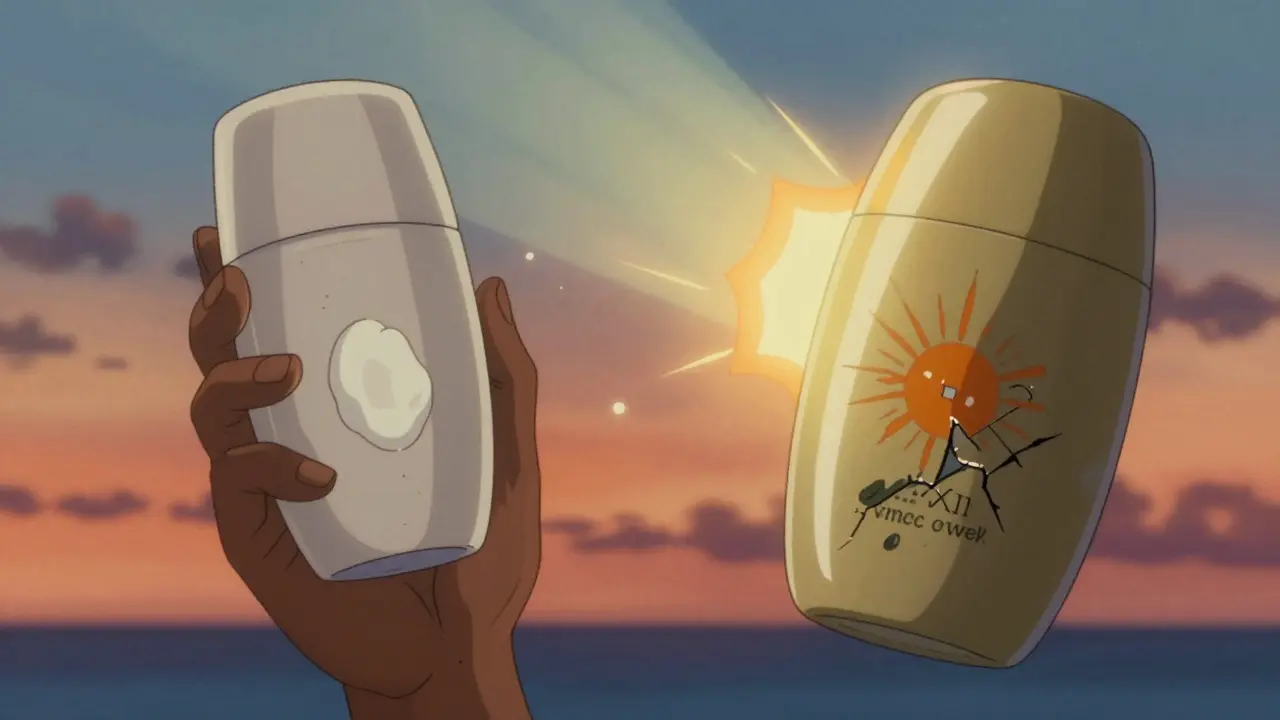
There are two types of active ingredients: mineral (zinc oxide, titanium dioxide) and chemical (avobenzone, octinoxate, oxybenzone). Mineral sunscreens sit on top of your skin and reflect UV light. Chemical ones absorb it. Both work - if they’re well-formulated.
Mineral sunscreens are great for sensitive skin, rosacea, or melasma. Dermatologists like Dr. Michele Green recommend EltaMD UV Clear SPF 46 (with 9% zinc oxide and niacinamide) for acne-prone or reactive skin. But they often leave a white cast - especially on darker skin tones. That’s why many people stop using them. And yes, some mineral sunscreens oxidize on skin and turn orange. That’s a formulation flaw, not a fault of mineral filters.
Chemical sunscreens are usually more cosmetically elegant. Supergoop! Unseen SPF 40 disappears on NC45 skin. Neutrogena Ultra Sheer SPF 55 feels like a moisturizer. But they need 15-20 minutes to activate. And some ingredients like oxybenzone are banned in Hawaii and Key West because they harm coral reefs. Even at 62 parts per trillion, oxybenzone can damage coral DNA. If you swim in oceans, lakes, or even public pools, choosing reef-safe formulas matters.
Reapplication: The Most Ignored Rule
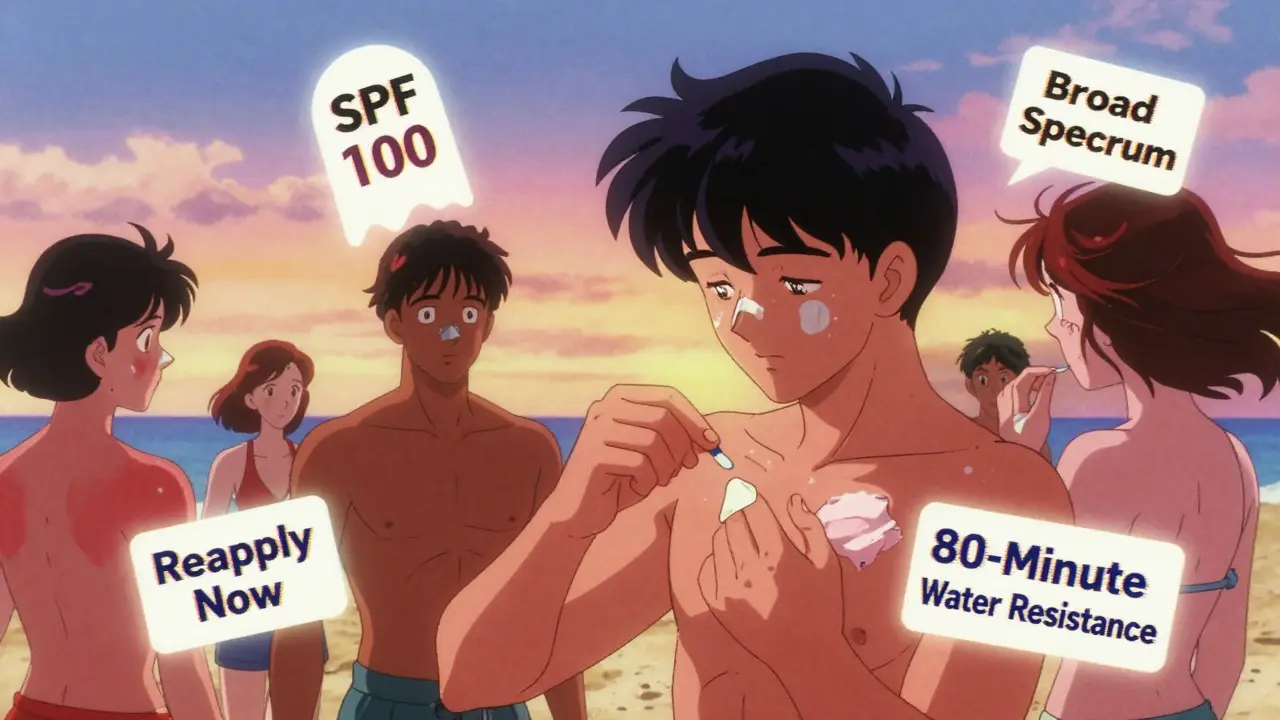
Here’s the hard truth: sunscreen wears off. Sweat, water, towel-drying, even just sitting in the sun - they all break it down. That’s why every dermatology organization says: reapply every two hours. And immediately after swimming or sweating - even if it says “80-minute water resistance.”
But here’s what nobody tells you: 80 minutes of water resistance doesn’t mean you’re protected for 80 minutes. It means you’ve passed a lab test where people soaked in chlorinated water for 80 minutes and still had some protection. Real life? You’re rubbing your face, drying off with a towel, and touching your skin. That removes sunscreen faster than you think.
Studies show only 14% of beachgoers reapply as recommended. On Reddit’s r/SkincareAddiction, 72% of users admit they skip reapplication during long days. That’s why you see people with peeling noses, red shoulders, and unexpected freckles. Reapplying doesn’t mean slathering on more. It means using the same amount you did the first time - about a quarter teaspoon for your face.
How Much Should You Really Use?
Let’s make this visual. For your face and neck, you need five to six pea-sized dots of sunscreen. Spread them out. Don’t just put it on your forehead and call it good. Rub it in. Wait 15 minutes before applying makeup. If it pills, you applied too soon or used too much product underneath. Try applying sunscreen before your moisturizer if you’re using a chemical filter. Mineral sunscreens? Apply after moisturizer.
Most people use 25-50% of what they need. That’s why SPF 50 feels like SPF 15. If you’re using a spray, spray it until it glistens, then rub it in. Don’t just mist and walk away. Spray twice as much as you think you need. And never use spray on windy days - you’re wasting product and inhaling chemicals.
What About Price? Is Expensive Better?
Not always. CVS Health SPF 50 spray costs $2.99. JLo Beauty’s SPF 30 moisturizer is $55. But price doesn’t equal protection. Consumer Reports found that mid-range products like Neutrogena Ultra Sheer and CeraVe Hydrating Mineral Sunscreen performed just as well as luxury brands. The real difference? Texture and ingredients for your skin type.
If you have oily skin, look for “non-comedogenic” and “oil-free.” If you have dry skin, look for hyaluronic acid or ceramides. If you’re dark-skinned, avoid titanium dioxide-heavy formulas - they leave a gray cast. Try Caravee Hydrating Sheer Sunscreen - it’s designed for melanin-rich skin and contains niacinamide to reduce redness. In a 30-day trial, 89% of users saw improved skin barrier function.
What’s Changing in 2025?
The FDA is finalizing new rules expected in late 2025. Here’s what’s changing:
- All sunscreens must meet UVA protection standards matching Europe’s (currently, U.S. standards are looser).
- SPF 15 will be the new minimum for non-broad spectrum products - but you should still use SPF 30+.
- Chemical filters like oxybenzone and octinoxate may be banned unless proven safe - which they haven’t been yet.
- Manufacturers will need to prove their SPF claims with real-world testing, not just lab conditions.
That means sunscreen labels will get more honest. No more “SPF 100” marketing. No more vague “water-resistant” claims. You’ll know exactly what you’re getting.
What You Should Do Right Now
Check your sunscreen. Look at the label. Does it say “broad spectrum”? Is the SPF 30 or higher? Is it water-resistant? Does it list zinc oxide or avobenzone as active ingredients? If you’re not sure, throw it out. Buy a new one.
Use a quarter teaspoon for your face. Reapply every two hours. If you’re outside, reapply after swimming or sweating. Don’t rely on makeup with SPF - you’re not applying enough. Skip the spray unless you’re going to rub it in.
And remember: sunscreen isn’t optional. The American Academy of Dermatology says daily use cuts melanoma risk by 50%. It prevents 90% of visible aging. You don’t need to spend $50. You just need to use it correctly.
Is SPF 100 better than SPF 50?
No. SPF 50 blocks 98% of UVB rays. SPF 100 blocks 99%. That extra 1% isn’t worth the hype. What matters is how much you apply and how often you reapply. Using SPF 100 and applying half as much gives you the protection of SPF 50 - or worse.
Do I need sunscreen on cloudy days?
Yes. Up to 80% of UV rays penetrate clouds. You can get sunburned even when it’s overcast. Daily sunscreen use isn’t just for beach days - it’s for walking the dog, driving, or sitting near a window.
Can I use last year’s sunscreen?
Most sunscreens last three years if stored properly. Check the expiration date. If there’s none, assume it’s good for two years after opening. If it smells weird, changed color, or separated, throw it out. Expired sunscreen doesn’t protect you.
Do dark skin tones need sunscreen?
Absolutely. Melanin offers some protection - but not enough. People of color still get skin cancer, often at later stages. They also get hyperpigmentation, melasma, and premature aging from UV exposure. Look for tinted mineral sunscreens or lightweight chemical formulas that don’t leave a white cast.
Is spray sunscreen safe?
Only if you rub it in. Sprays are convenient but hard to apply evenly. You risk inhaling chemicals and missing spots. Use them outdoors, away from wind, and always rub them in until they disappear. Never use sprays on children’s faces - spray into your hands first, then apply.


trudale hampton
March 22, 2026 AT 09:26Really glad someone broke this down without the hype. I used to think SPF 100 was overkill until I realized I was slathering on maybe a pea-sized amount and calling it a day.
Now I use a quarter teaspoon for my face and reapply every time I go outside - even if it’s just to grab the mail. Game changer.
Allison Priole
March 22, 2026 AT 18:23omg yes i had no idea that mineral sunscreens could turn orange like that lol i thought it was just my skin being weird
also i always use sprays because they’re fast but now im gonna spray twice and rub it in like a maniac lmao
also why does every sunscreen smell like a summer camp? just saying
Sandy Wells
March 22, 2026 AT 20:23Most people dont even know what broad spectrum means let alone how much to apply
Its not rocket science but youd think it was
And dont get me started on the $55 JLo moisturizer with SPF 30
Its just marketing
Chris Dwyer
March 23, 2026 AT 04:34Youre doing your skin a massive favor by reading this and actually changing habits
Its not about being perfect its about being consistent
Even if you only reapply once a day now thats better than never
Start small and build from there - your future self will thank you
Solomon Kindie
March 24, 2026 AT 08:57SPF is a placebo wrapped in a marketing scheme designed to make you feel safe while corporations profit
Real protection comes from shade clothing and not being outside at all
But we live in a world where people pay $50 for sunscreen but wont buy a hat
Its not ignorance its systemic delusion
Bryan Woody
March 24, 2026 AT 15:13Let me guess - you’re the person who uses SPF 50 spray and thinks you’re covered because you ‘did the thing’
Bro you sprayed it once and walked away
That’s not sunscreen that’s a prayer
And if you’re using spray on a windy day you’re basically giving your lungs a UV cocktail
Stop being lazy and rub it in
Its not that hard
matthew runcie
March 26, 2026 AT 14:13Good breakdown. I’ve been using CeraVe Mineral for a year now and it doesn’t leave a cast on my medium skin.
Reapplication is still my weak spot but now I keep a mini bottle in my bag.
Small step.
shannon kozee
March 28, 2026 AT 05:50Use a quarter teaspoon for face. That’s it. No more guessing.
And reapply after swimming - even if it says 80 minutes.
Simple. Effective.
Shaun Wakashige
March 30, 2026 AT 04:38SPF 100 = scam 😎
Paul Cuccurullo
March 31, 2026 AT 23:03This is one of those rare pieces of health advice that actually saves lives - not just prevents wrinkles.
Every person who reads this and changes one habit just dodged a potential diagnosis.
That’s not just skincare - that’s radical self-preservation.
Thank you for writing this.
Nicole James
April 1, 2026 AT 23:16Wait - so you’re telling me the FDA doesn’t regulate sunscreen like it does drugs? And companies can just put SPF 100 on a bottle and not prove it? And oxybenzone is still legal? And they test on only fair-skinned people? And we’re supposed to trust this? This is a public health disaster in slow motion.
Who profits? Who gets hurt? Who’s lying? I need answers.
And why is no one talking about this?!
Nishan Basnet
April 2, 2026 AT 18:30As someone from India where sun exposure is constant year-round, I’ve learned the hard way - sunscreen isn’t optional, it’s survival.
Mineral sunscreens work better for darker skin if they’re formulated right - Caravee is a game-changer.
Reapplication is non-negotiable. I carry a tiny tube in my pocket.
And yes - clouds don’t save you. I got sunburned on a rainy day once. Never again.
Timothy Olcott
April 4, 2026 AT 14:00AMERICA IS THE ONLY COUNTRY THAT DOES SUNSCREEN RIGHT 🇺🇸
SPF 100? YES. MINERAL? YES. REAPPLY? YES.
OTHER COUNTRIES? THEY USE TAN OIL AND PRAY 😤
WE WIN AT SKIN 🤘