
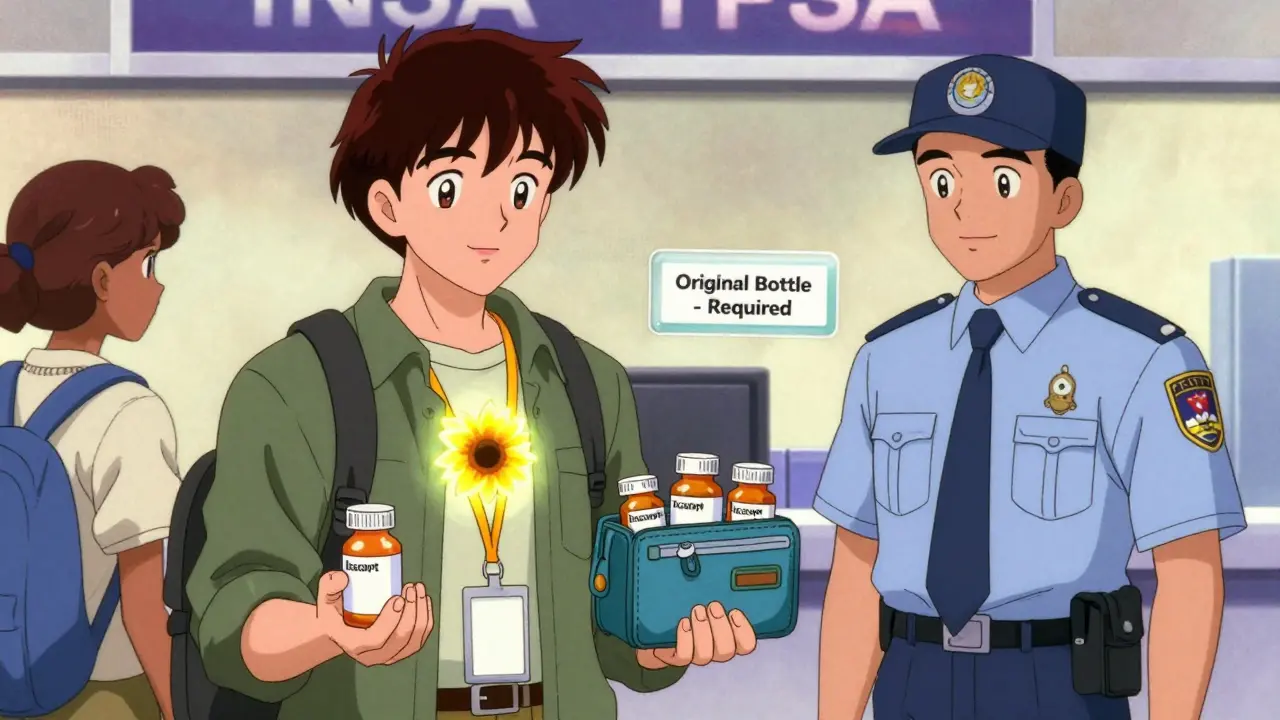
Getting through airport security with your meds doesn’t have to be a nightmare. But if you don’t know the rules, you could end up losing your pills, stuck in a long line, or worse-denied entry into another country. Millions of people travel with medications every year, and most of them do it without a hitch. The problem? Too many people wait until the last minute to check what’s allowed. By then, it’s too late.
What the TSA Actually Lets You Bring
The Transportation Security Administration (TSA) doesn’t ban medications. In fact, they encourage you to bring them. But they need to know what you’re carrying. Solid pills? No limits. You can bring your whole medicine cabinet in your carry-on. Liquids? That’s where things get tricky. The old 3.4-ounce rule still applies to most liquids, but medications are exempt. You can bring more than 3.4 ounces of liquid insulin, liquid painkillers, or any other medically necessary liquid-no need to pour it out. Just tell the officer at the checkpoint. Declare it. Show it. And keep it separate from your other liquids.Pro tip: Keep your meds in their original pharmacy bottles. TSA officers see hundreds of pill bottles every day. If yours has a clear label with your name, the drug name, and the pharmacy, you’re 63% less likely to get pulled aside for extra screening. Unlabeled pills? That’s a red flag. Even if they’re legal, they look suspicious. Don’t risk it.
International Rules? They’re Wildly Different
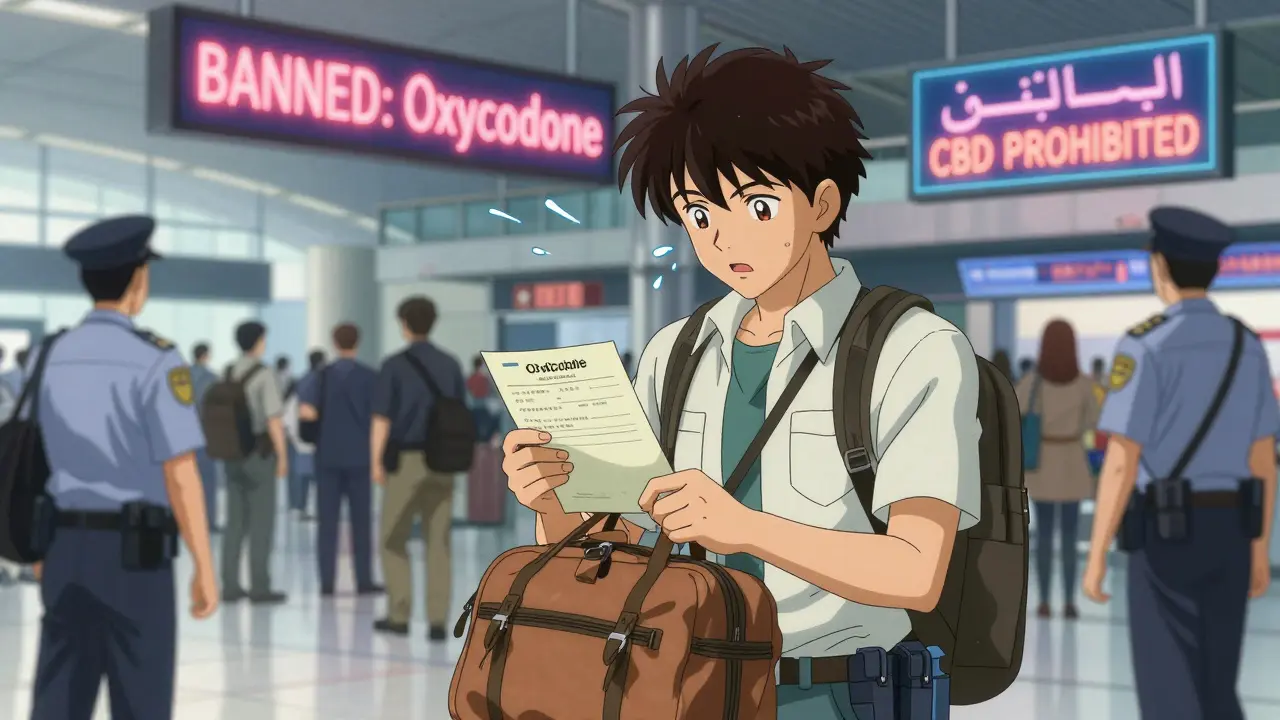
Here’s the thing: what’s legal in the U.S. isn’t always legal elsewhere. Japan doesn’t allow any medication with pseudoephedrine-that’s in most cold and allergy pills. Thailand requires special permission to bring Xanax or Valium. The UAE bans all opioids, even if you have a prescription from your doctor. And Adderall? It’s outright illegal in 17 countries, including France and Sweden.The CDC’s Yellow Book lists five common medications that cause the most trouble abroad: hydrocodone, oxycodone, alprazolam, diazepam, and zolpidem. If you take any of these, you need to do your homework before you book your flight. The International Narcotics Control Board (INCB) says always contact the embassy of your destination country. Don’t rely on websites or travel blogs. Embassy websites are updated regularly. And if you’re unsure, ask them directly. It takes 15 minutes. It could save your trip.
And don’t forget about CBD. Even if it’s legal in your state, 29 countries-including Dubai and Singapore-ban it completely, no matter how little THC it contains. One traveler I spoke with got detained in Thailand because her “hemp oil” bottle had 0.1% THC. She didn’t even know it was there. Check the label. Check the law.
How to Store Medications Safely
If you’re carrying insulin, biologics, or other temperature-sensitive drugs, you can’t just toss them in your bag. These meds need to stay between 36°F and 46°F (2°C-8°C). Heat, cold, and sunlight can ruin them. A regular cooler won’t cut it. You need a pharmaceutical-grade cooling wallet. These are lightweight, reusable, and tested to hold temperature for up to 72 hours-even in 100°F heat. They cost $20-$50, but they’re cheaper than a hospital visit.Insulin users: 73% who used these wallets during tropical trips reported zero issues with their meds. That’s not luck. That’s preparation. And if you’re flying with an insulin pump or other electronic device? The lithium battery has to stay in your carry-on. FAA rules say you can’t check it. You also can’t bring a spare battery over 100 watt-hours without airline approval. Most pumps use under 30 watt-hours, so you’re fine. Just don’t pack the battery in your suitcase.
Refills and Extended Stays
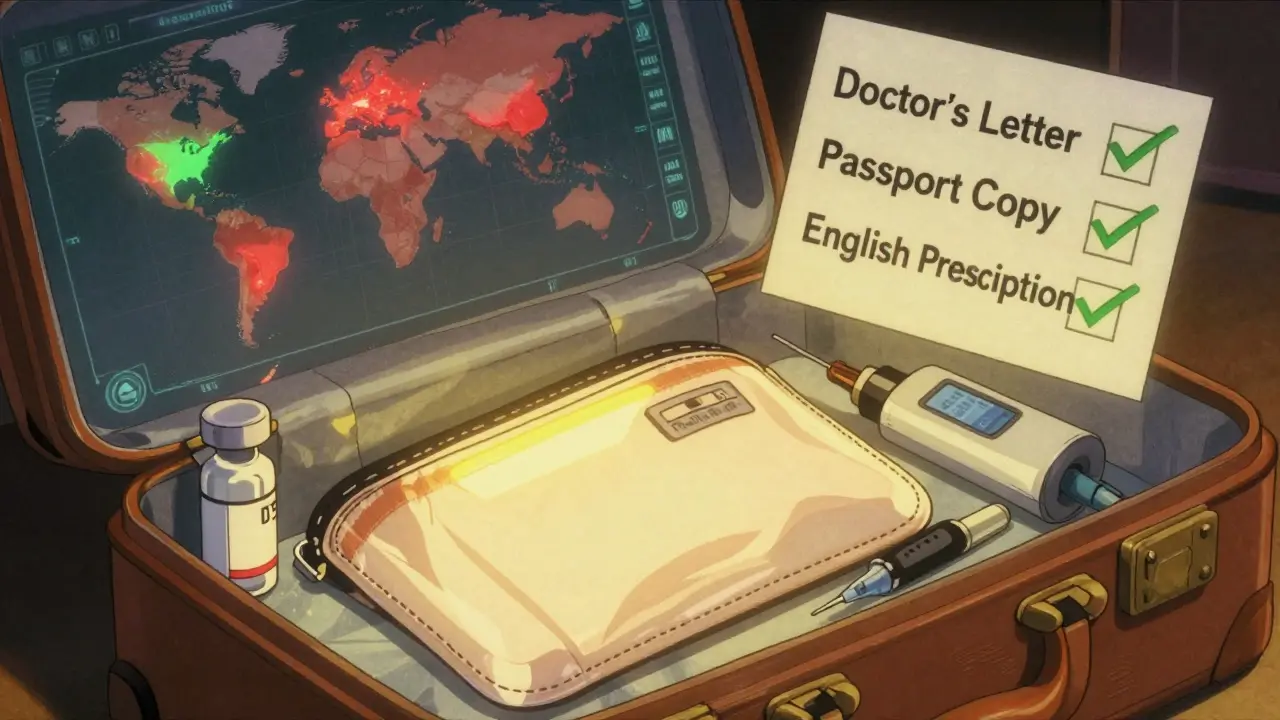
You’re going overseas for six months. Your prescription runs out in 60 days. What now? The FDA lets you bring in a 90-day supply for personal use. That’s it. No more. But if you’re staying longer, you can have additional medication mailed to you. You’ll need three things: a copy of your passport, a letter from your doctor explaining why you need it, and a copy of your prescription in English. The FDA says they’ll accept it if it’s for a chronic condition and you’re not selling it.Some countries have portals where you can apply for pre-approval before you even leave. Germany, Canada, and Australia are among the 19 that now let you submit documents online. It takes 3-5 business days. Start early. Don’t wait until your pills are gone.
Documentation You Can’t Skip
Here’s what you need to carry:- Original prescription bottles with your name and pharmacy info
- A doctor’s letter on letterhead explaining your condition and why you need each medication
- Translated copies of your prescriptions if you’re going to a non-English-speaking country
- A list of all your meds, including dosages and why you take them
67% of countries require the original bottle. 83% of travelers who didn’t bring translated prescriptions got questioned or delayed. And 100% of international travelers who carried a doctor’s letter reported smoother screening. It’s not optional. It’s your insurance.
How to Avoid Getting Stuck at Security
TSA has a program called TSA Cares. It’s free. You can request it 72 hours before your flight. They assign you a specialist who helps you through security. They’ll even give you a sunflower lanyard to wear-so staff know you need extra help. If you’re carrying complex meds or devices, use it. It cuts your screening time by 41%.Also, don’t pack all your meds in one bag. Put some in your carry-on. Put some in your purse. Put a few in your checked luggage (if they’re stable). That way, if your bag gets lost, you’re not left without your heart meds or your insulin. 92% of travelers who used this strategy avoided treatment disruption.
What’s Changing in 2025 and Beyond
More countries are going digital. 31 now accept electronic prescriptions. Some airports in the U.S. have special “medication-friendly” lanes at 37 major hubs. You’ll see signs that say “Medication Screening Area.” It’s faster. It’s quieter. Use it.The World Health Organization is pushing for global standards by 2027. They want to cut medication-related travel problems by 25%. But until then, you’re on your own. The rules change fast. A country that allowed oxycodone last year might ban it this year. That’s why you check embassy websites. That’s why you call ahead.
What Not to Do
Don’t hide your meds. Don’t put them in a different container. Don’t assume your prescription is enough. Don’t wait until you’re at the airport to check the rules. And don’t think “it’s just a small amount.” One pill can trigger a full investigation.There’s no shame in asking for help. TSA officers aren’t trying to be mean. They’re trained to spot threats. If you’re clear, organized, and honest, they’ll help you. But if you’re sneaky, they’ll treat you like a suspect.
Can I bring my medications in a pill organizer?
Yes, but only if you also carry the original prescription bottles. TSA and international customs want to see the pharmacy label. A pill organizer is fine for convenience, but never as your only proof of legitimacy. Keep the originals with you at all times.
What if my medication is banned in my destination country?
If your medication is banned, you cannot bring it-even with a prescription. Some countries allow you to apply for a special permit before travel, but this is rare and takes weeks. If you can’t get approval, talk to your doctor about alternatives. There’s almost always a substitute. Don’t risk detention or deportation.
Do I need to declare my meds at customs when I arrive?
In most countries, yes. The customs form often asks if you’re carrying medications. Answer honestly. If you’re unsure, declare it anyway. It’s better to explain it to an officer than to get caught hiding it. Many countries have a green channel for travelers with medical needs. Use it.
Can I mail my medications to myself while traveling?
Yes, if you’re staying longer than 90 days. You need: a doctor’s letter, your passport copy, and an English-language prescription. Mail it to your hotel or a trusted contact. Don’t send it to a PO box unless you’re sure the country accepts it. The FDA allows this for personal use, but customs may still open and inspect it.
Are there apps or websites to check medication rules by country?
Yes. The CDC’s Travelers’ Health site and the INCB’s online database are the most reliable. Also check the U.S. State Department’s travel advisories. Avoid third-party apps unless they link directly to government sources. Many are outdated or inaccurate. Always verify with official government sites.
Traveling with meds isn’t about being paranoid. It’s about being prepared. You’ve managed your health. Now manage your travel. Do the research. Pack smart. Ask questions. And don’t assume anything. The world doesn’t follow U.S. rules. But if you know the rules of where you’re going, you’ll get through every checkpoint-no stress, no delays, no surprises.



Daniel Dover
February 15, 2026 AT 00:51Stop overcomplicating it.
Chiruvella Pardha Krishna
February 15, 2026 AT 22:34Joe Grushkin
February 16, 2026 AT 18:00Virginia Kimball
February 18, 2026 AT 06:56Sarah Barrett
February 19, 2026 AT 22:29Kapil Verma
February 20, 2026 AT 09:25Michael Page
February 21, 2026 AT 21:09Mandeep Singh
February 22, 2026 AT 04:07Betty Kirby
February 24, 2026 AT 03:43Erica Banatao Darilag
February 25, 2026 AT 07:59