Imagine waking up and feeling like your ears are stuffed with cotton, or noticing that the world sounds like it's underwater. For many, this isn't just a temporary annoyance from a cold; it's conductive hearing loss is a type of hearing impairment that happens when sound can't travel efficiently from the outer ear to the cochlea in the inner ear . Unlike permanent nerve damage, this issue is often a "mechanical" failure. Whether it's a buildup of fluid, a hole in the eardrum, or a bone that won't vibrate, the problem is that the sound is being blocked. The good news? Because the inner ear is usually healthy, many of these blocks can be fixed surgically.
What Exactly Blocks the Sound?
To understand why you're struggling to hear, you have to look at the middle ear as a relay station. If any part of the equipment is broken, the signal doesn't get through. One of the most frequent culprits in children is otitis media with effusion, often called "glue ear." This occurs when fluid builds up behind the eardrum, turning the middle ear into a swamp that sound waves can't easily penetrate. In fact, about 80% of kids experience this by age three.
In adults, we often see different patterns. Some people deal with a perforated tympanic membrane, which is just a medical way of saying a hole in the eardrum. This can happen from a loud blast, a bad infection, or even a misplaced cotton swab. When the eardrum can't vibrate as a single unit, sound leaks out and doesn't push forward into the ear.
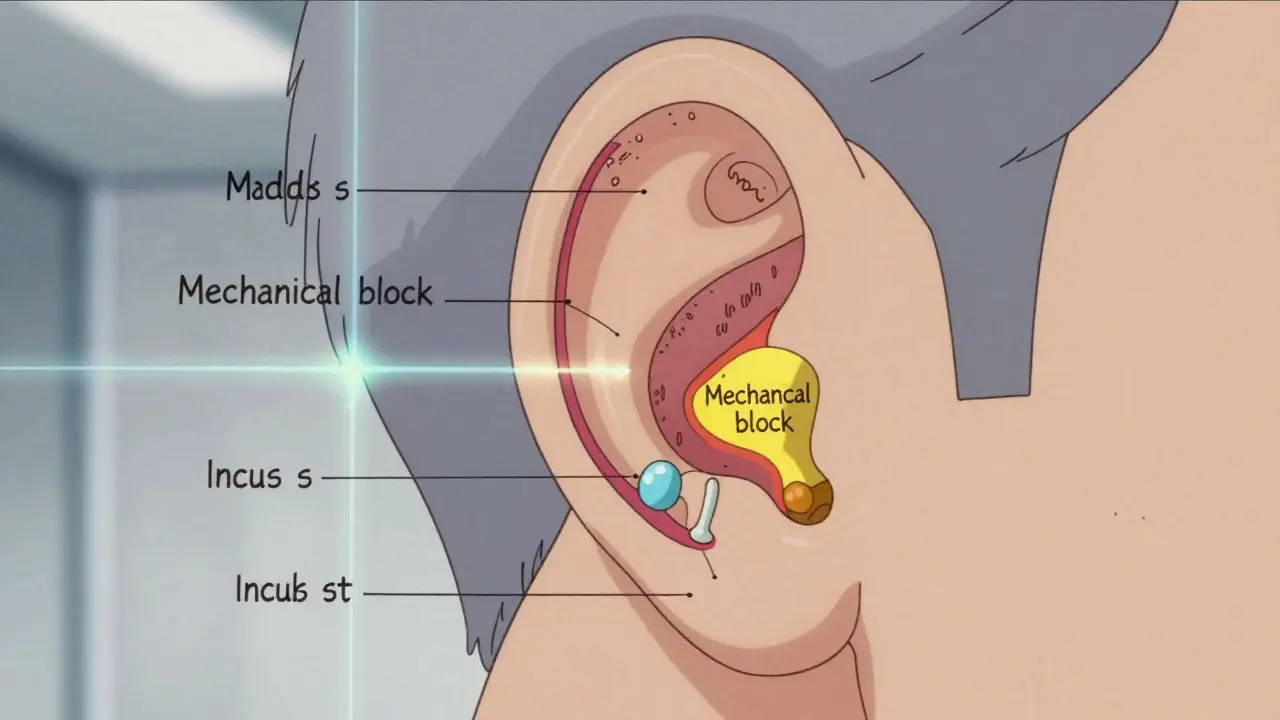
Then there are the structural issues. Otosclerosis is a condition where the stapes (the smallest bone in your body) essentially freezes in place. If the stapes can't move, it can't push sound into the inner ear. On the more serious side, there's cholesteatoma, which is a skin cyst that grows in the middle ear. These aren't just blocking sound; they can actually eat away at the surrounding bone, making them a medical priority to remove.
How Doctors Pinpoint the Problem
You can't just guess which part of the ear is failing. A basic screening at a pharmacy isn't enough because it doesn't tell you why you can't hear. A professional audiologist uses a specific method called air-and-bone conduction testing. By comparing how you hear sound through the air versus how you hear it when the sound vibrates the skull bone directly, they can find an "air-bone gap." If you hear better through the bone than through the air, it's a classic sign of conductive loss.
Doctors also use tympanometry, a quick test that puffs a little air into your ear to see how the eardrum moves. If the graph shows a "Type B" curve-basically a flat line-it's a huge red flag for fluid in the middle ear, appearing in about 92% of glue ear cases.
| Condition | What's Happening? | Primary Symptom | Typical Fix |
|---|---|---|---|
| Otitis Media | Fluid buildup | Muffled sound, pressure | Tubes (Tympanostomy) |
| Otosclerosis | Stapes bone fusion | Gradual hearing loss | Stapedectomy |
| Perforation | Hole in eardrum | Hearing drop, drainage | Tympanoplasty |
| Cholesteatoma | Skin cyst growth | Hearing loss, discharge | Surgical Removal |
Surgical Options: Fixing the Mechanical Break
Surgery for the ear is all about precision. Depending on the diagnosis, the approach changes completely. For those with chronic fluid in the ears, the most common move is tympanostomy tubes. These are tiny cylinders placed in the eardrum to let fluid drain and air enter. It's one of the most common pediatric surgeries in the US, with roughly 667,000 children getting them every year. Most of these kids see a total resolution of symptoms within three months.
If the eardrum itself is torn, a tympanoplasty is used to patch the hole. Surgeons often use a graft from the patient's own tissue. The success rates are impressive-between 85% and 95% for small holes. Recent jumps in tech, like bioengineered grafts, are pushing these success rates even higher by using a specialized extracellular matrix.
For the "frozen bone" of otosclerosis, a stapedectomy or stapedotomy is the answer. The surgeon removes the immobile part of the stapes and replaces it with a tiny prosthetic. Thanks to laser-assisted techniques, the complication rate has plummeted from 15% down to less than 2%. Many patients report they can suddenly hear whispers again or finally turn the TV volume down.
Cholesteatoma surgery is different because the goal isn't just hearing-it's safety. The surgeon must remove the cyst entirely to prevent it from destroying the temporal bone. Once a "safe, dry ear" is created, they then look at reconstructing the hearing mechanism if it was damaged.
What to Expect During Recovery
Recovery isn't a "one-size-fits-all" process. If you're getting tubes, you're usually back to normal almost immediately. However, for more complex reconstructions like a tympanoplasty, you'll need to be careful. You generally have to keep your ear completely dry for about six weeks. No swimming and no showering without heavy-duty plugs. You also have to avoid pressure changes-so don't go diving or fly on a plane without talking to your doctor first for about eight weeks.
Those recovering from cholesteatoma surgery often face a longer road. Many patients report needing four to six weeks before they feel ready to return to a full work or school schedule. Some also notice a change in how sound quality feels for a while as the brain adjusts to the new physical structure of the ear.
There are some risks to keep in mind. While rare, about 7% of stapedectomy patients experience temporary vertigo (dizziness), and a few might notice a strange taste in their mouth or a temporary increase in tinnitus. These are usually short-lived, but it's worth knowing so you don't panic when they happen.
The Future of Ear Repair
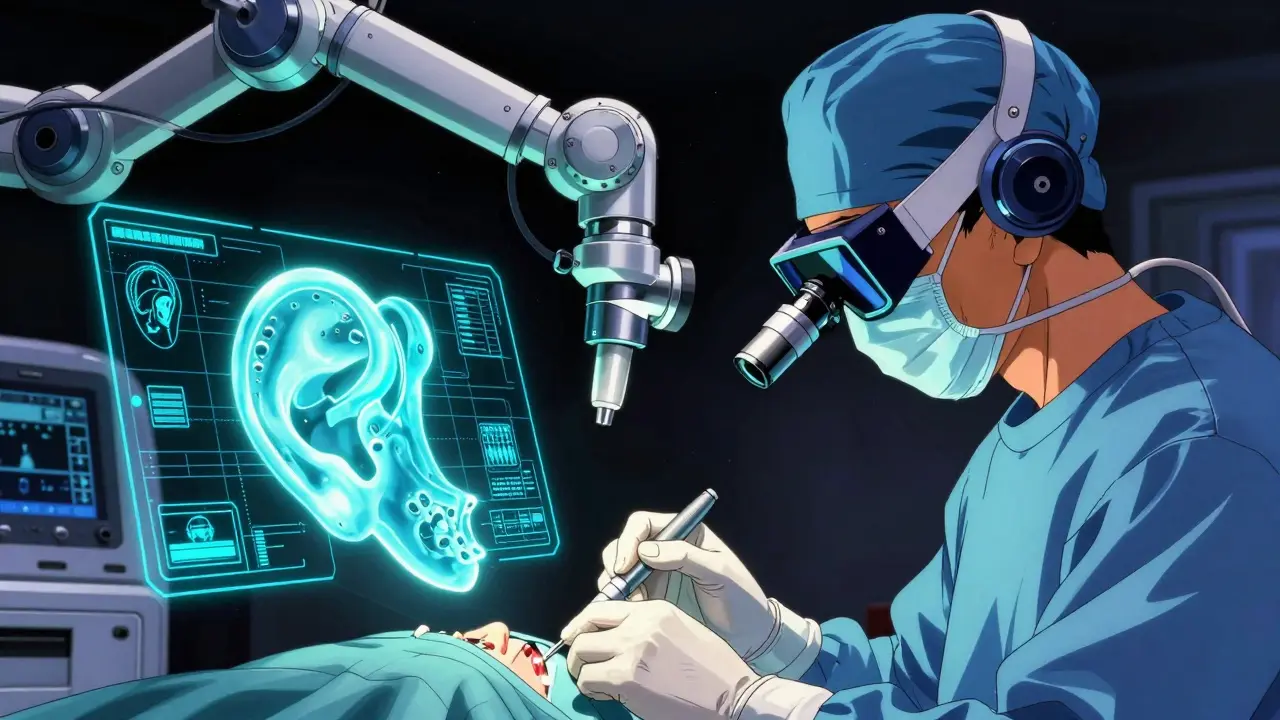
We are moving toward a world where ear surgery is less invasive and more personalized. High-resolution CT scans are already the gold standard for planning, but 3D printing is the next frontier. Doctors are now testing 3D-printed ossicular prostheses customized to the exact anatomy of the patient's ear, which has shown a 94% improvement rate in early trials.
Additionally, endoscopic surgery is taking over. Instead of making a large incision behind the ear, surgeons can use a tiny camera to go through the ear canal. Experts predict this will be the standard for 60% of all middle ear procedures by 2028, potentially cutting recovery times in half.
Can conductive hearing loss be treated without surgery?
Yes, many cases can. For instance, earwax impaction is easily cleaned, and some types of fluid buildup in children resolve on their own with medical management. About 65% of pediatric cases are solved without needing surgery. However, structural issues like otosclerosis or dangerous growths like cholesteatoma almost always require surgical intervention.
How do I know if my hearing loss is conductive or sensorineural?
You cannot tell by yourself. You need an audiologist to perform a bone-conduction test. If the sound travels better through the bone of your skull than through the air into your ear canal, it indicates a conductive problem. Sensorineural loss involves the inner ear (cochlea) or the auditory nerve, and the bone-conduction test would show a similar loss to the air-conduction test.
Are tympanostomy tubes permanent?
No, most tubes are designed to fall out on their own. They typically stay in place for 6 to 18 months, eventually being pushed out by the skin of the eardrum. In most cases, the small hole they leave behind heals naturally without any further treatment.
Is stapedectomy a permanent fix for otosclerosis?
For the vast majority of people, yes. Replacing the frozen stapes bone with a prosthetic restores the mechanical vibration needed for hearing. About 80-90% of patients see their hearing gap close to within 10 dB, which is considered a highly successful outcome.
What happens if a cholesteatoma is left untreated?
Untreated cholesteatomas are dangerous because they are locally destructive. They can erode the small bones of the middle ear, lead to severe chronic infections, and in rare cases, penetrate the skull or affect the balance center of the inner ear. This is why they are treated as an immediate surgical priority regardless of how much hearing loss is present.
Next Steps and Troubleshooting
If you suspect you have a hearing problem, the first step is a high-quality diagnostic exam. Avoid the "quick tests" at retail stores; you need a full audiogram with air and bone conduction measurements. If you are diagnosed with conductive loss, ask your ENT about the "air-bone gap" in decibels. If that gap is larger than 25-30 dB and hasn't improved with medication for three months, you are likely a candidate for surgery.
For parents, keep a log of your child's ear infections. If your child is struggling with speech development or frequently asks "what?", a tympanometry test can quickly determine if glue ear is the culprit. If surgery is recommended, ensure you have a clear plan for postoperative ear care, especially regarding water avoidance, to ensure the grafts or tubes stay in place.