

Imagine waking up with the feeling that there is a handful of sand in your eyes. For millions of people, this isn't a bad dream-it's a daily reality. Dry Eye Syndrome is a chronic condition where your eyes either don't produce enough tears or produce poor-quality tears, leading to inflammation and irritation. Also known as Dry Eye Disease (DED), it affects over 16 million adults in the U.S. alone. While it might seem like a minor annoyance, ignoring it can lead to permanent corneal scarring in some chronic cases.
Why Your Eyes Feel Dry: The Two Main Types
Not all dry eye is created equal. If you're reaching for drops, it's important to know why your eyes are dry in the first place, because the solution for one type might not work for the other. There are two primary ways this happens: aqueous deficiency and evaporation.
First, there is Aqueous Tear-Deficient Dry Eye (ADDE). This happens when your lacrimal glands-the ones responsible for the watery part of your tears-simply aren't keeping up. This represents about 10-15% of cases. It's often linked to Sjogren's syndrome, an autoimmune disorder, or it can be a side effect of medications like antihistamines. If you're over 50, the likelihood of this type of deficiency increases significantly as the glands age.
Then there is Evaporative Dry Eye (EDE). This is far more common, accounting for roughly 86% of all cases. In this scenario, you might actually be producing plenty of water, but it's evaporating too fast. This usually happens because of Meibomian Gland Dysfunction (MGD). These glands produce the oily layer of the tear film. Without that oil, your tears vanish into thin air at rates much higher than normal-sometimes over 16 nanoliters per minute compared to the usual 4-8.
Understanding the Tear Film Layers
To understand how artificial tears help, you have to understand what a "real" tear actually is. It's not just water; it's a sophisticated three-layer sandwich:
- The Lipid Layer: A tiny oily film (0.1-0.2 μm) that prevents evaporation.
- The Aqueous Layer: The thick middle layer (7-10 μm) that hydrates and cleanses.
- The Mucin Layer: A thin coating (0.02-0.05 μm) that helps the tear stick to the eye surface.
When any of these layers fail, the "break-up time" of your tears drops. A healthy eye keeps its tear film intact for 15-35 seconds. If yours breaks up in under 10 seconds, you're heading toward inflammation and ocular surface damage.
| Feature | Aqueous Deficiency (ADDE) | Evaporative Dry Eye (EDE) |
|---|---|---|
| Prevalence | ~10-15% of cases | ~85-90% of cases |
| Primary Cause | Lacrimal gland failure / Sjogren's | Meibomian Gland Dysfunction (MGD) |
| Tear Problem | Not enough water produced | Water evaporates too quickly |
| Best OTC Approach | Standard hydrating drops | Lipid-based/Oil-supplemented drops |

Choosing the Right Artificial Tears
Walking down the eye care aisle at a pharmacy can be overwhelming. You'll see dozens of bottles, but they generally fall into a few specific categories. The key is matching the ingredients to your specific symptoms.
For mild cases, standard lubricant drops work well. These contain viscosity agents like Carboxymethylcellulose or Hyaluronic Acid. Hyaluronic acid is particularly effective because it holds onto water longer; for instance, a 0.15% concentration can provide relief for up to 4 hours, whereas basic saline might only last a couple of hours.
If you're using drops more than four times a day, you need to look for "preservative-free" options. Many standard drops contain benzalkonium chloride, a preservative that can actually damage the surface of the eye if used too frequently. Switching to preservative-free single-dose vials can improve symptoms by over 37% in severe cases because it removes that chemical irritation.
For those with evaporative dry eye, look for "lipid-layer" or "oil- lidded" drops. These mimic the natural oils from the meibomian glands and stop the water from evaporating so quickly. If you're a contact lens wearer, always check for compatibility; some thicker drops can leave a gritty residue on lenses, while others are specifically formulated for them.
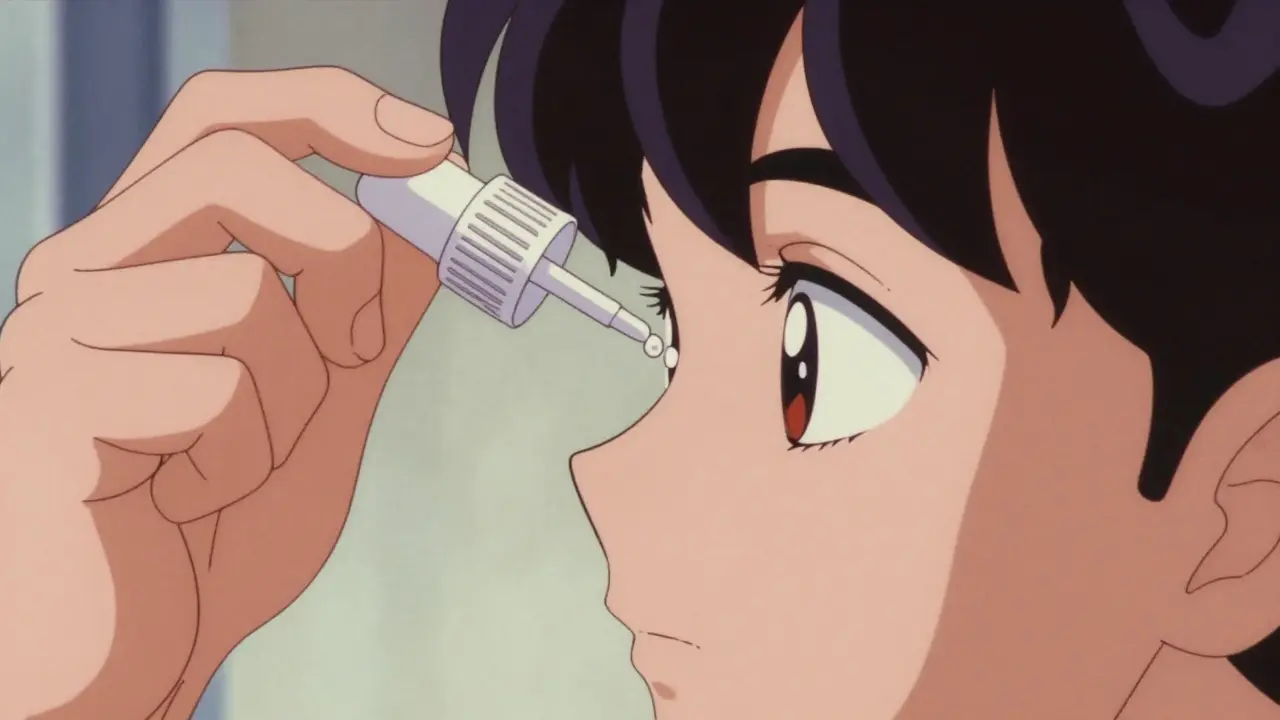
How to Use Eye Drops Like a Pro
It sounds simple, but most people do it wrong. Applying too many drops or touching the eye with the bottle can cause more harm than good. Here is the most effective way to administer your drops:
- Tilt your head back at a 45-degree angle.
- Gently pull your lower eyelid down to create a small pocket.
- Hold the bottle about 1cm away from the eye-don't let the tip touch your eye or lashes.
- Squeeze a single drop into the pocket. Using two or three drops is a waste; your eye can't hold that much liquid, and the rest just runs down your cheek.
- If you are using two different types of medication, wait at least 5 minutes between them so the first one doesn't get washed away.
Pro Tip: Try refrigerating your drops. The cold temperature can help soothe inflammation and slightly increase the viscosity of the liquid, helping it stay on your eye longer.
When Artificial Tears Aren't Enough
Artificial tears are like a bandage-they treat the symptom, but they don't always fix the cause. If you're using drops five times a day and still feel like your eyes are burning, you might be dealing with an inflammatory cycle. When tears become too salty (hyperosmolar), they trigger a cascade of inflammatory proteins that damage the corneal surface.
In these moderate-to-severe cases, you'll need prescription treatments. Medications like Cyclosporine or Lifitegrast work by reducing the inflammation of the glands themselves. There are also newer options like the TrueTear neurostimulator, which uses electrical impulses to encourage your body to produce its own natural tears again.
You should seek a specialist if you notice your vision fluctuating or if the dryness is accompanied by intense pain that doesn't go away with drops. If a standard routine of artificial tears hasn't helped after 4 to 6 weeks, it's time for a professional diagnostic test, such as a Schirmer test or osmolarity measurement.
Can I use artificial tears too often?
It depends on the preservatives. If you use drops with preservatives (like benzalkonium chloride) more than 4-6 times a day, you risk damaging the ocular surface. For frequent use, always switch to preservative-free single-dose vials to avoid toxicity.
Why do my eyes water if I have dry eye syndrome?
This is called paradoxical tearing. When your eye becomes severely dry or irritated, it sends a panic signal to the lacrimal glands to flood the eye with water. However, because the oil layer is missing, this "emergency water" just rolls off the eye without hydrating it, leaving you dry again almost immediately.
Do artificial tears cure dry eye?
No, artificial tears are a management tool, not a cure. They replace missing moisture and protect the surface, but they don't fix the underlying gland dysfunction or autoimmune issues causing the deficiency.
Are gel drops better than liquid drops?
Gels and ointments are more viscous, meaning they stay on the eye longer. They are excellent for nighttime use to prevent waking up with dry eyes, but they can cause blurred vision, making them impractical for daytime use.
Can screen time cause dry eye?
Yes. When we stare at screens, our blink rate drops significantly. This prevents the eye from refreshing the tear film, leading to faster evaporation and a higher risk of developing chronic dry eye symptoms.


mimi clouet
April 14, 2026 AT 05:27Omg, a total game changer! 🌟 I actually started using the preservative-free vials months ago and the difference is literally night and day. Also, for anyone struggling, don't forget that Omega-3 supplements can help the oil quality of your tears from the inside out! ✨💖
S.A. Reid
April 14, 2026 AT 16:31One must wonder if the proliferation of these "lipid-based" solutions is merely a sophisticated marketing ploy by Big Pharma to ensure lifelong dependency. It is quite plausible that these chemicals are designed to slightly irritate the ocular surface to justify further consumption of the product. I find it profoundly suspicious that the medical establishment insists on this specific regimen without addressing the potential electromagnetic influences of our modern devices on glandular secretion.