
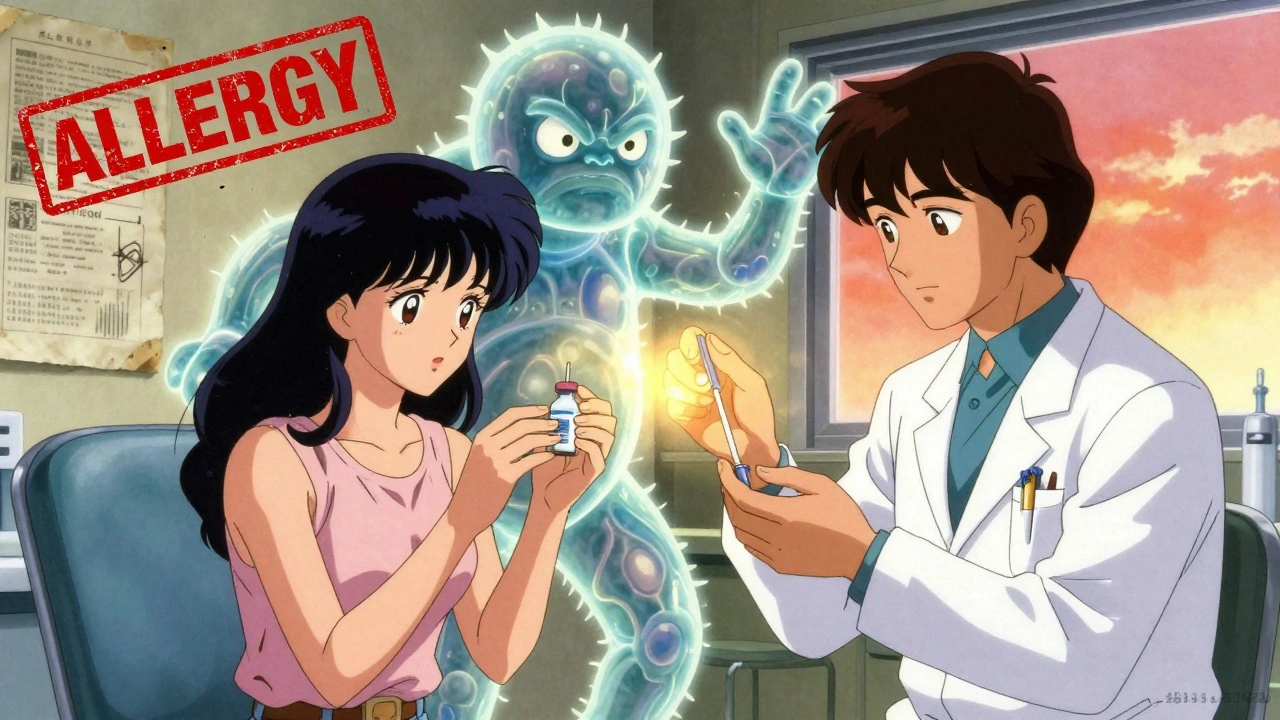
Over 10% of people in the U.S. say they’re allergic to penicillin. But here’s the twist: up to 90% of them aren’t. That’s not a typo. Most people who think they’re allergic to penicillin can safely take it again-after the right tests. The same goes for NSAIDs like ibuprofen or aspirin. The problem isn’t always the drug. It’s the label. And that label can cost you more, make you sicker, or even limit your treatment options when you’re fighting a serious infection or cancer.
What Really Counts as a Drug Allergy?
A true drug allergy is an immune system response. It’s not just a stomach ache or a rash that goes away. It’s your body mistaking a medication for a threat. Symptoms show up fast-within minutes to an hour. Think hives, swelling, trouble breathing, low blood pressure, or vomiting. These are signs of an IgE-mediated reaction, the kind that can turn dangerous fast. But here’s where people get confused. Many reactions aren’t allergies at all. Nausea from antibiotics? That’s a side effect. A headache after ibuprofen? Probably not an allergy. Even a rash from amoxicillin in kids is often viral, not allergic. The problem is, once you’re labeled allergic, that tag sticks. Doctors avoid the drug. You get stronger, more expensive antibiotics. And you pay more-studies show about $500 extra per hospital stay just because of that label.Penicillin: The Most Misdiagnosed Allergy
Penicillin is the classic example. It’s one of the safest and most effective antibiotics. But because of how often it’s mislabeled, it’s also one of the most avoided. Skin testing is the gold standard for checking if you’re truly allergic. A tiny amount of penicillin is placed under your skin. If there’s no reaction, you get a full oral dose of amoxicillin as a challenge. If you tolerate that, you’re cleared. But here’s the catch: many clinics still use outdated tests. The old PPL (Prepared Penicillin Polylysine) test is unreliable. Up to 70% of people who test positive to PPL alone don’t react to real penicillin. That’s why experts now say: skip PPL. Use only major and minor determinant antigens. If skin tests are negative, you’re almost certainly safe.NSAIDs: A Different Kind of Reaction
NSAID allergies work differently. They’re not usually IgE-driven. Instead, they’re linked to how your body handles prostaglandins. People with asthma or nasal polyps are more likely to react. Symptoms can include wheezing, nasal congestion, or hives-often within an hour. Unlike penicillin, you can’t test for NSAID allergy with a skin prick. The only way to know for sure is through a controlled challenge. That’s where desensitization comes in. For patients who need aspirin long-term-for heart disease or arthritis-daily, gradually increasing doses can reset the body’s response. Start at 30 mg of aspirin. Increase to 60 mg, then 100 mg, then 150 mg, then 325 mg over several hours. Once you reach the full dose, you can keep taking it daily without reaction. This isn’t a one-time fix. You have to keep taking it every day to stay desensitized.
Desensitization: How It Works and When It’s Used
Desensitization isn’t a cure. It’s a temporary workaround. You’re not changing your immune system permanently. You’re tricking it into tolerating the drug-for one treatment cycle. Once you stop, the tolerance fades. If you need the drug again later, you’ll need to go through it all over again. The most common protocol is the 12-step method. It’s used for IV drugs like penicillin, cefazolin, or even chemotherapy agents like paclitaxel. You start with a dose that’s 1/10,000th of the full amount. Every 15 to 20 minutes, you double the dose. The whole process takes 4 to 8 hours. Some newer protocols, like the one at Brigham and Women’s Hospital, can do it in under 3 hours by tripling doses every 15 minutes. It’s not done in a doctor’s office. You need a hospital setting with emergency equipment ready. Anaphylaxis can happen. Staff must be trained. Epinephrine must be on hand. If you go into laryngeal edema or can’t stabilize your blood pressure, the procedure stops.Who Gets Desensitized?
Desensitization isn’t for everyone. You need two things: a confirmed immediate reaction, and no safe alternative. That’s why it’s common in cancer care. If you’re allergic to a chemotherapy drug like paclitaxel and there’s no other option, desensitization lets you keep living. Same with severe infections. If you’re allergic to penicillin but have meningitis or endocarditis, you need it. No choice. It’s also used for antibiotics like nafcillin, ceftriaxone, and ceftazidime. Even oral drugs like fluconazole or itraconazole have been successfully desensitized. And yes-it’s being tried for non-IgE reactions too. Not just immediate ones. Some patients with delayed rashes are now being included in trials.The Pediatric Gap
Most desensitization protocols were built for adults. Kids are different. Their immune systems react differently. Their weight matters. Their dosing isn’t just a scaled-down version. Yet, pediatric allergists rarely have the training or resources to do it. Most children who need it are referred to adult centers, where staff aren’t always familiar with pediatric dosing or developmental needs. Experts agree: we need pediatric-specific protocols. Children with cancer, cystic fibrosis, or recurrent infections need access. But right now, there’s a gap. Few hospitals have dedicated pediatric desensitization teams. That’s changing slowly. More collaboration between allergists, infectious disease doctors, and oncologists is happening-but it’s still not standard.
Why This Matters Beyond the Clinic
This isn’t just about one drug or one reaction. It’s about antibiotic resistance. When we avoid penicillin because of a misdiagnosis, we use broader-spectrum drugs. Those kill more good bacteria. They push resistant strains to grow. That’s why the CDC calls penicillin allergy labeling a public health issue. It’s also about cost. A single course of a broad-spectrum antibiotic can cost $1,000. Penicillin? $10. A skin test? $150. Desensitization? $500-$1,000. All of that is cheaper than weeks of wrong antibiotics, longer hospital stays, or ICU care from resistant infections. And it’s about dignity. People shouldn’t be denied life-saving drugs because of a label they got as a child, or a rash that turned out to be harmless.What You Should Do If You Think You’re Allergic
If you’ve been told you’re allergic to penicillin or an NSAID:- Don’t assume it’s true. Ask for a referral to an allergist.
- Get skin testing for penicillin. If negative, ask for a drug challenge with amoxicillin.
- If you need an NSAID long-term and have reactions, ask about daily aspirin desensitization.
- Never stop a drug on your own if you’re in treatment. Talk to your doctor and an allergy specialist together.
Desensitization Isn’t Perfect-But It’s Powerful
It’s not risk-free. There’s a 2% chance of resensitization after re-exposure, especially with IV penicillin. But the benefits outweigh the risks for people with no alternatives. The technology is proven. The protocols are detailed. The success rates are high-over 90% for beta-lactams, 85% for NSAIDs. The real barrier isn’t science. It’s access. Most hospitals don’t have allergy teams trained in desensitization. Insurance doesn’t always cover it. Patients don’t know it exists. The future? More standardization. More collaboration. More pediatric protocols. More education. And fewer people labeled allergic when they’re not.Can you outgrow a penicillin allergy?
Yes, many people do. About 50% lose their penicillin allergy within 5 years, and 80% by 10 years. But without testing, you won’t know if it’s gone. Don’t assume you’re still allergic just because you had a reaction years ago. Skin testing and a supervised challenge are the only reliable ways to confirm.
Is desensitization safe for children?
Yes, when done properly. Children with IgE-mediated allergies to antibiotics or chemotherapy drugs can be desensitized successfully. But protocols must be adjusted for weight and age. Most current guidelines are based on adult data, so it’s critical to work with a pediatric allergist who has experience with the procedure. Hospitals with pediatric allergy programs are starting to offer this, but it’s still not widely available.
Can you desensitize to multiple drugs at once?
No. Desensitization is done one drug at a time. Trying to desensitize to two drugs together increases risk and confuses the results. If you need multiple drugs, you’ll go through separate protocols. Each one is treated as its own event. After one is complete, you wait until the next treatment cycle to start another.
What happens if you miss a day of NSAID desensitization?
If you’re on daily aspirin or NSAID desensitization and miss a dose for more than 48 hours, you lose tolerance. You’ll need to restart the full protocol. That’s why it’s only used for patients who need the drug long-term-like those with heart disease or chronic inflammation. If you’re taking it only occasionally, desensitization isn’t recommended.
Are there alternatives to desensitization for drug allergies?
Yes, but only if they exist. For penicillin, alternatives include vancomycin, clindamycin, or fluoroquinolones-but they’re less effective, more toxic, or more expensive. For NSAIDs, acetaminophen is often used, but it doesn’t work for inflammation. For chemotherapy, other drugs may be available, but they might not work as well for your cancer type. Desensitization is used when there’s truly no other option.
How long does a desensitization last?
Only for the duration of the treatment course. Once you stop taking the drug, your immune system forgets the tolerance. If you need the drug again in the future-even weeks or months later-you’ll need to go through desensitization again. It’s not permanent. But for people who need the drug urgently, it’s life-saving.



Heidi Thomas
December 4, 2025 AT 18:26Stop wasting time with skin tests. If you had a rash once you’re allergic period. Doctors are just trying to sell you more antibiotics.
Rachel Bonaparte
December 5, 2025 AT 19:54Look I get it, the system wants you to believe penicillin is safe because Big Pharma profits off it. But have you ever heard of the 1998 CDC memo that quietly admitted 70% of penicillin allergy tests were false positives because they were using outdated reagents? No? Of course not. That’s because they buried it. Now they’re pushing this ‘desensitization’ nonsense so you’ll keep taking the same drugs while they jack up the price on alternatives. And don’t get me started on how insurance refuses to cover testing but will pay for three rounds of vancomycin. This isn’t medicine. It’s a revenue model disguised as science.
Martyn Stuart
December 7, 2025 AT 19:34Really important post. Many people don’t realize that a penicillin label can lead to broader-spectrum antibiotics, which drive antimicrobial resistance. Skin testing is underutilized, and the PPL test is outdated-major determinant antigens are the way to go. If you’ve been told you’re allergic, please, get evaluated. It’s not just about cost-it’s about public health. Also, desensitization protocols for chemotherapy are life-changing for patients with no alternatives. This deserves way more attention.
Libby Rees
December 8, 2025 AT 21:51It is important to understand that a true drug allergy involves the immune system. Many reactions are side effects or coincidental. A rash in a child on amoxicillin is often due to a viral infection, not an allergy. Mislabeling leads to inappropriate antibiotic use and increased costs. Testing and challenge protocols are safe and effective. Patients should be referred to allergists for evaluation.
Shofner Lehto
December 9, 2025 AT 15:21I’ve seen this firsthand in the ER. A patient comes in with pneumonia, labeled penicillin-allergic, gets clindamycin, develops C. diff, ends up in ICU. Meanwhile, penicillin would’ve cleared it in 48 hours. The label isn’t just inaccurate-it’s dangerous. We need better education for providers and patients. Stop assuming. Test. Confirm. Don’t let a childhood rash dictate adult treatment.
Isabelle Bujold
December 10, 2025 AT 09:15I’ve worked in oncology for over a decade, and desensitization to paclitaxel has saved more lives than most people realize. It’s not glamorous, but when you have a patient with metastatic breast cancer who’s allergic to every other taxane and the only option left is paclitaxel, you don’t say no. The protocol is meticulous-12 steps, incremental dosing, emergency meds ready. And yes, it’s expensive and time-consuming. But it’s better than watching someone die because we were too scared to try. The real tragedy isn’t the procedure-it’s that so few hospitals offer it. We need more centers, more training, more funding. This isn’t experimental. It’s standard of care for those with no alternatives.
Augusta Barlow
December 10, 2025 AT 20:16Okay but who’s really behind this push to ‘reclassify’ penicillin allergies? Is it the AMA? The CDC? Or is it the same people who told us vaccines were safe and the flu shot worked? I mean, if you’re really so sure about desensitization, why aren’t they doing it in every clinic? Why is it only in fancy hospitals? Why do they need a 4-hour protocol and IV epinephrine on standby? Sounds like a controlled experiment to me. And what about the people who had real anaphylaxis? Are they just being ignored because the data says ‘most’ are wrong? I’m not buying it. This feels like a corporate reset of patient history to make drugs cheaper to prescribe. I’ve seen too many people get sicker after being told they ‘weren’t allergic.’
Joe Lam
December 11, 2025 AT 01:05Let’s be real-most people who say they’re allergic to penicillin just had a stomachache in 2003 and now they’re stuck with a label that makes them sound like a medical mystery. The fact that 90% of them aren’t actually allergic? That’s not a coincidence. That’s a systemic failure of medical documentation. And yet, no one wants to be the one to say, ‘Hey, maybe you’re not allergic.’ Too risky. Too much liability. So we just keep prescribing vancomycin like it’s candy. Meanwhile, the CDC is screaming about antibiotic resistance and nobody’s listening because we’d rather be safe than… accurate.
Ollie Newland
December 11, 2025 AT 03:07Desensitization for NSAIDs is wild. You’re basically training your body to ignore the prostaglandin disruption by slowly flooding it with aspirin. It’s not magic-it’s immunological habituation. But the catch? You gotta keep taking it daily. Miss a dose? Back to square one. That’s why it’s only for folks who need it long-term-heart patients, arthritis sufferers. For occasional pain? Just take Tylenol. But if you’re on daily aspirin for stents? This is a game-changer. Still, most GPs don’t know about it. Gotta push your allergist for it.
Rebecca Braatz
December 12, 2025 AT 01:14If you’ve been told you’re allergic to penicillin, don’t let that label hold you back. Get tested. It’s simple, safe, and could save you thousands-and maybe your life. This isn’t just about antibiotics. It’s about your right to accurate care. Don’t let outdated info from a childhood rash dictate your future. You deserve better. Talk to an allergist today. You’ve got nothing to lose and everything to gain.
Gillian Watson
December 13, 2025 AT 07:48I’m British and we’ve been doing penicillin skin testing for years. It’s routine. No drama. No fear. Just a prick, wait 15 minutes, if no reaction you’re cleared. We don’t have this ‘label panic’ here. People take penicillin like it’s aspirin. And guess what? The UK has lower rates of MRSA than the US. Coincidence? I think not. We need to stop treating drug allergies like superstitions.
Jordan Wall
December 14, 2025 AT 19:42So… desensitization is like… *snaps fingers*… rewiring your immune system? 😎 I mean, imagine if we could do this for gluten or lactose? Like… ‘Hey immune system, chill out, it’s just a drug bro.’ 🤯 I did it for cefazolin last year-4 hours, no probs. Now I’m basically penicillin-approved. Also, my doc used PPL and I cried. Don’t use PPL. Use the good stuff. Also, can we desensitize to my ex? Asking for a friend. 💔
val kendra
December 14, 2025 AT 23:54I had a rash on amoxicillin at age 6. Got labeled allergic. 20 years later, I got tested-negative. Took amoxicillin again for a sinus infection. No problem. Cost me $150 for the test. Saved me $1,200 on antibiotics and a week of being sick. If you think you’re allergic, get it checked. It’s not scary. It’s just science. Stop letting a childhood mistake define your health.
George Graham
December 15, 2025 AT 15:53My sister needed desensitization for paclitaxel after her ovarian cancer diagnosis. She was terrified. The whole process felt like walking through fire. But the team was calm, patient, and explained every step. She got through it. Now she’s in remission. I wish more people knew this was possible. It’s not a last resort-it’s a lifeline. And it’s not just for adults. Kids need it too. We need pediatric protocols. We need more hospitals to offer this. No one should be denied treatment because of a label.
Rachel Bonaparte
December 16, 2025 AT 00:50Oh, so now the experts say PPL is junk? Funny how they never mentioned that in the 2000s when my aunt got anaphylaxis after a ‘negative’ PPL test. You know what’s really dangerous? When doctors trust bad science and then tell patients they’re ‘fine’ after a flawed test. You think the 2% resensitization rate is the risk? Nah. The real risk is trusting a system that changes its mind every decade and then acts like it never had a problem. I’ve seen people die because they were told they weren’t allergic. So don’t give me your ‘90% are wrong’ stats. That’s not reassurance-that’s a warning.