
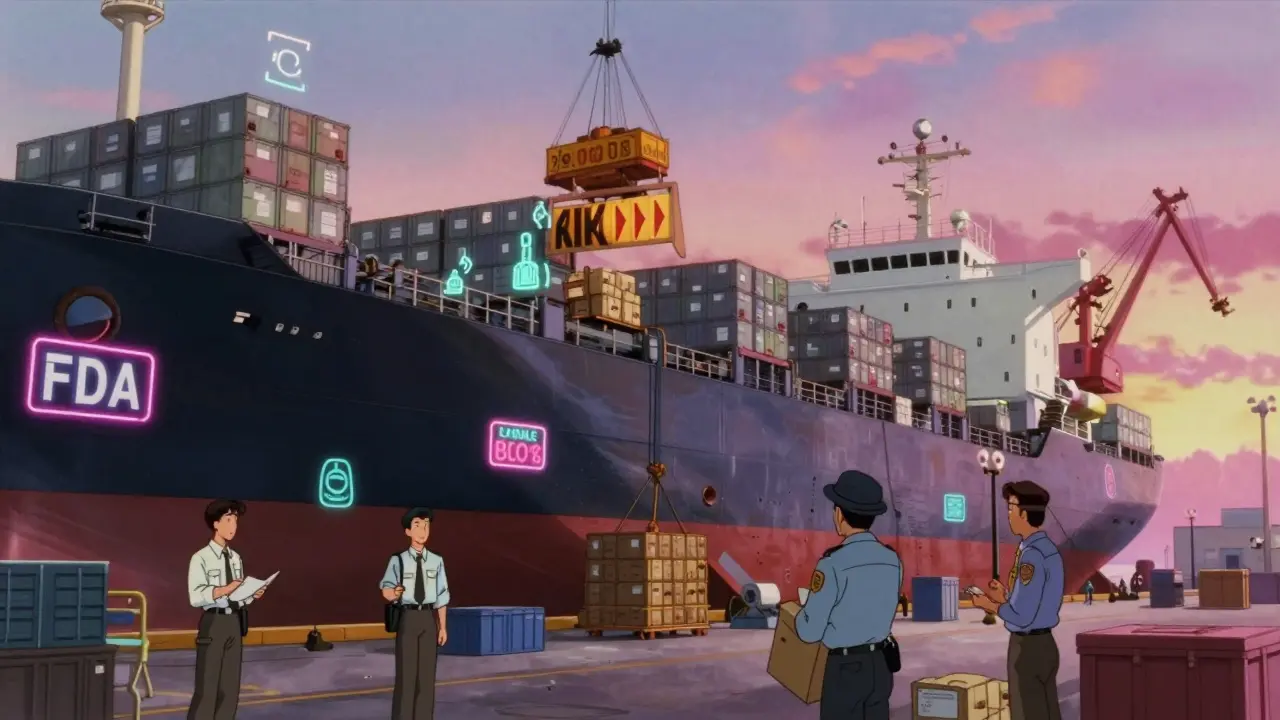
The U.S. imports over $186 billion worth of drugs every year. That’s more than 40% of all medications used in America. But how does the FDA make sure those drugs are safe? It’s not just a stamp on a box. It’s a complex, high-stakes system that stops contaminated, fake, or illegal drugs before they reach your medicine cabinet.
Every Drug Entry Gets Screened - Even Small Shipments
In 2023, the FDA closed a major loophole. Before, small packages under $800 - called "de minimis" shipments - could slip through without inspection. That’s how counterfeit pills, unapproved injectables, and even pill presses slipped into the country. Now, every single FDA-regulated drug shipment, no matter how small, is reviewed. That includes online orders from overseas pharmacies and samples sent to researchers. This change added over 350,000 new entries to the FDA’s workload in just one year.The Five-Step Inspection Process
The FDA doesn’t open every box. It uses a smart, risk-based system with five clear steps:- Entry Submission: Importers must file electronic notices before the drug arrives. This includes details like the product name, manufacturer, quantity, and port of entry.
- Entry Review: A computer system scans 98% of entries in seconds. It flags anything suspicious - a manufacturer with past violations, a product listed on an FDA warning list, or incomplete paperwork.
- Examination and Sampling: If flagged, the shipment is held. FDA inspectors might check the label, examine the packaging, or take 1-3 units for lab testing. They look for signs of tampering, incorrect ingredients, or missing safety info.
- Compliance Review: The FDA checks if the product meets U.S. standards: Is the manufacturer registered? Are the ingredients listed? Does the label match FDA rules? If not, the product gets detained.
- Final Admissibility Decision: The FDA decides: admit, refuse, or request reconditioning. In 2022, 14.3% of physically inspected drug shipments were detained. Of those, nearly 7 out of 10 were permanently blocked.
Who Gets Checked - And Who Gets a Pass
Not all importers are treated the same. The FDA runs a special program called the Secure Supply Chain Pilot Program (SSCPP). It’s for manufacturers with a clean, three-year track record. These companies can get their drugs cleared in under 48 hours - down from 7-10 days. As of late 2023, only 27 companies qualified, including big names like Johnson & Johnson. Their secret? Perfect compliance. No violations. No delays. No surprises. But for everyone else, it’s a gamble. At the Port of Los Angeles, only 5.2% of drug shipments get detained. At the Port of Miami, it’s 18.7%. Why the difference? It’s not random. It’s based on past data - which manufacturers, which countries, which product types have the highest failure rates. Generic drugs from certain facilities in India and China face detention rates as high as 37% - even if they’re perfectly made. The system is catching patterns, not just mistakes.
What Gets You Detained
If your drug gets held, it’s almost always because of one of these issues:- Unregistered manufacturer: Every factory making drugs for the U.S. must be registered with the FDA. If it’s not, the shipment is stopped.
- Missing or wrong labeling: Labels must list ingredients, dosage, manufacturer, and warnings in English. Typos or missing info can trigger detention.
- Not approved: Even if a drug is legal in another country, it’s illegal in the U.S. unless FDA-approved.
- Contaminated or substandard: The 2022 valsartan recall started because a Chinese supplier used a carcinogenic chemical. That drug passed customs once - but the FDA caught it in testing.
- Incomplete paperwork: One missing form can delay a shipment for days. Importers often blame the FDA. The truth? Most delays come from sloppy documentation.
The Hidden Costs and Real-World Problems
This system isn’t perfect. The FDA inspects only about 1.2% of the 100 million+ drug shipments that enter each year. That means most drugs are cleared without ever being touched. It works - most of the time. But when it doesn’t, the consequences are serious. A 2023 Government Accountability Office report found the FDA hasn’t fully implemented 13 of 17 key safety metrics required by law. That’s not just bureaucracy. It means gaps in detection. Small biotech startups are feeling the squeeze. Before 2023, they could send research samples under $800 with no hassle. Now, each shipment costs $285-$420 extra and adds 3-5 days to their timeline. Academic labs are reporting delays that slow down clinical trials. Meanwhile, generic drug makers say they’re being punished. Teva Pharmaceuticals reported that even compliant suppliers in India are getting hit with detention orders at a 37% rate. Why? The FDA’s system flags entire countries based on past problems - even if the specific factory is clean.
What Importers Need to Get It Right
If you’re shipping drugs into the U.S., here’s what actually works:- Use the right codes: 28% of delays come from incorrect product codes. Double-check the FDA’s Harmonized System codes.
- Verify registration: Go to the FDA’s Drug Establishment Registration database. If the factory isn’t listed, fix it before shipping.
- Label correctly: FDA rules for labeling are strict. No abbreviations. No foreign language only. No missing lot numbers.
- Keep records for 3 years: You must store every invoice, test result, and shipment document. Audits happen - and fines are steep.
- Build relationships: Experienced importers say knowing the FDA reviewer at your port cuts delays by 22-35%. Call them. Ask questions. Don’t wait for problems.
The Future: AI, Blockchain, and More
The FDA isn’t standing still. By 2025, it plans to use AI to predict which shipments are most likely to be unsafe - improving detection accuracy by 25%. A blockchain pilot will let inspectors trace a drug from factory to shelf in real time. And by 2024, the Secure Supply Chain Program will expand to 50 companies, including contract manufacturers. But the biggest challenge remains: e-commerce. The FDA estimates that 41% of websites selling drugs to Americans operate outside U.S. law. Those shipments are hard to track. The agency is working with customs and international partners, but it’s a race against shadow pharmacies.Bottom Line
The FDA’s import system isn’t flawless. It’s underfunded, inconsistent, and sometimes unfair. But it’s the only thing standing between you and a fake heart pill, a tainted antibiotic, or a contaminated vaccine. For big companies with clean records, it’s efficient. For small players and generic makers, it’s a minefield. And for consumers? It’s the invisible shield keeping dangerous drugs off the shelves.How often does the FDA inspect imported drugs?
The FDA physically inspects only about 1.2% of all drug shipments entering the U.S. each year. That’s roughly 1.2 million out of over 100 million entries. The rest are cleared based on electronic screening, manufacturer history, and risk algorithms. But every single shipment is reviewed electronically before it arrives.
Can I import drugs for personal use?
The FDA generally allows personal imports of small quantities of unapproved drugs - like a 90-day supply of a prescription medication - if it’s for a serious condition and no U.S.-approved alternative exists. But this is discretionary. The FDA can and does seize shipments that look like commercial imports or involve controlled substances. Don’t assume it’s legal just because you’re buying for yourself.
What happens if my drug shipment is detained?
If your shipment is detained, you’ll get a notice from the FDA explaining why. You have 10 days to respond. You can either fix the issue (like relabeling or providing missing documents), request a hearing, or abandon the shipment. If you don’t respond, the FDA will destroy or export the drugs at your expense. Detention doesn’t mean automatic refusal - but it does mean delays and costs.
What is a Detention without Physical Examination (DWPE)?
DWPE is a tool the FDA uses to block shipments from manufacturers or countries with a history of violations. If a company or country is on a DWPE list, every future shipment from them is automatically held - no inspection needed. You can’t just send a new sample. You have to prove you’ve fixed the problem, which can take months and requires a formal request to the FDA.
How can I check if my drug manufacturer is FDA-registered?
Go to the FDA’s Drug Establishment Registration database at fda.gov/Drugs/DevelopmentApprovalProcess/RegistrationListing. Search by company name or facility location. If the facility isn’t listed, it’s not approved to export to the U.S. - and any shipment from it will likely be detained.
Do I need a customs broker to import drugs?
You’re not legally required to use one, but 85% of pharmaceutical importers do. The process involves dozens of forms, strict deadlines, and complex FDA rules. A good broker knows which ports are faster, how to code products correctly, and how to respond to detention notices. For small companies, the cost ($285-$450 per entry) is cheaper than the risk of delays or seizures.




Kathy Scaman
January 28, 2026 AT 05:47So they inspect 1.2% of shipments and call it a day? That’s like locking your front door but leaving the back window wide open with a sign that says ‘free stuff here’.
Phil Davis
January 28, 2026 AT 21:02They’re not wrong to be suspicious. But the way they treat entire countries like criminal enterprises? That’s not risk-based - it’s racial profiling with a lab coat.
Mindee Coulter
January 30, 2026 AT 15:41My cousin works at a generic pharma plant in India and says the FDA inspectors show up once a year and leave with a smile if the paperwork’s clean. The rest is just fear and bureaucracy.
Bryan Fracchia
January 31, 2026 AT 03:00I get why they do it. I really do. But when a small research lab can’t get a vial of a new compound through customs without paying $400 and waiting five days, we’re not protecting patients - we’re protecting patents.
The system rewards big players and punishes innovation. That’s not safety. That’s stagnation dressed up as regulation.
Timothy Davis
February 1, 2026 AT 22:53Let’s be real - 37% detention rate for Indian manufacturers? That’s not ‘risk-based.’ That’s a tariff disguised as a public health policy. The FDA’s algorithm is just a glorified spreadsheet that hates developing countries.
And don’t get me started on the ‘Secure Supply Chain’ program. It’s a VIP pass for Big Pharma while everyone else gets stuck in customs purgatory.
They call it inspection. I call it economic warfare with a clipboard.
Sue Latham
February 3, 2026 AT 00:16Anyone who thinks this system is fair clearly hasn’t tried to import a prescription they need from Canada. It’s not about safety - it’s about control. The FDA doesn’t want you to have cheaper drugs. They want you to pay what they say.
And don’t even mention ‘personal use’ - that’s just a loophole they’ll shut next month.
Amber Daugs
February 4, 2026 AT 16:29People who complain about delays are the same ones who buy ‘miracle cures’ off Instagram. If you’re not willing to follow the rules, you don’t deserve to get medicine at all. This isn’t Amazon. It’s your life we’re protecting.
Stop whining. The system works. It’s just not convenient for you.
James Dwyer
February 4, 2026 AT 22:08I’ve shipped medical supplies overseas for years. The real issue isn’t the FDA - it’s the importers who don’t read the damn guidelines. Half the detentions are from typos in product codes or missing forms. Fix your house before blaming the police.
jonathan soba
February 5, 2026 AT 23:44Interesting how the FDA’s ‘risk-based’ model conveniently aligns with U.S. trade policy. No coincidence that detention rates spike for countries the U.S. has trade disputes with. This isn’t science - it’s geopolitics in a lab coat.
matthew martin
February 7, 2026 AT 12:20Imagine if your car got pulled over every time it crossed state lines - not because it was broken, but because the DMV didn’t like the color. That’s what this feels like. The FDA isn’t policing drugs - it’s policing geography.
And yet, somehow, we still get safe meds. The system’s broken, but it’s broken in a way that still kinda works. That’s the American way.
Chris Urdilas
February 8, 2026 AT 07:23They’re using AI now? Cool. Next they’ll be using blockchain to track aspirin from a factory in Bangalore to your bathroom cabinet. Meanwhile, the guy who actually needs the drug is waiting three weeks because someone forgot to check a box.
Technology doesn’t fix bad policy. It just makes the delay look fancy.
Irebami Soyinka
February 9, 2026 AT 21:42USA thinks it owns medicine now? 😒 India makes 40% of the world’s generics. You want cheap insulin? You want affordable antibiotics? Then stop treating our factories like drug cartels. This isn’t safety - it’s arrogance with a badge.
Next you’ll ban our spices because ‘somebody once got sick from a bad curry’.
SRI GUNTORO
February 9, 2026 AT 23:08India is not a safe source for drugs. The FDA is right to be strict. I have seen too many fake medicines in my own country. If the system stops even one bad pill from reaching America, it’s worth it.
Don’t blame the FDA for your laziness. Learn the rules. Register your factory. Follow the labels. Simple.
Anna Lou Chen
February 10, 2026 AT 09:19The entire paradigm is predicated on a false epistemology of regulatory omniscience. The FDA’s algorithmic determinism reifies a neoliberal biopolitical regime wherein pharmaceutical sovereignty is commodified through performative compliance.
By fetishizing documentation over phenomenological safety - i.e., the lived experience of patients - the system becomes a performative theater of control, where the act of auditing supersedes the ethics of care.
Blockchain? Please. We need a post-capitalist pharmacopeia, not a blockchain ledger for profit-driven gatekeeping.