
Vitamin K Intake Calculator for Warfarin Patients
Track Your Vitamin K Intake
This calculator helps you maintain consistent vitamin K intake between 90-120 µg daily for stable INR levels while on warfarin.
Selected Foods
Your Vitamin K Intake
Important Notes
Consistency is key. Your goal is to maintain intake within a narrow range day-to-day. The target range of 90-120 µg daily helps keep your INR stable.
Remember: Cooking concentrates vitamin K significantly. 1 cup of cooked spinach contains over 6 times more vitamin K than raw spinach.
When you're on warfarin, your diet isn't just about eating healthy-it's about eating consistent. A sudden change in what you eat, especially foods high in vitamin K, can send your INR levels flying or crashing. And that’s not just inconvenient-it’s dangerous. You don’t need to avoid spinach, kale, or broccoli. You just need to eat the same amount, every day.
Why Vitamin K Matters with Warfarin
Warfarin works by blocking vitamin K’s ability to help your blood clot. That’s why it’s effective at preventing strokes and blood clots. But here’s the catch: vitamin K doesn’t just disappear when you eat it. It builds up in your body and directly fights against warfarin’s effect. If you eat a lot of vitamin K one day and almost none the next, your INR (the measure of how long it takes your blood to clot) will swing like a pendulum.Studies show that a 50% increase in vitamin K intake can drop your INR by 0.5 to 1.0 within just a few days. That’s enough to make your blood too thin-or too thick. And when your INR is out of range, your risk of stroke or dangerous bleeding goes up.
The good news? You don’t need to starve yourself of greens. The American Heart Association, the American College of Cardiology, and the American Society of Hematology all agree: consistency beats restriction. Patients who eat about 90-120 micrograms (µg) of vitamin K daily, with little variation, spend 75-80% of their time in the safe INR range. Those who eat wildly different amounts each day? Only 55-65%.
Which Foods Are High in Vitamin K?
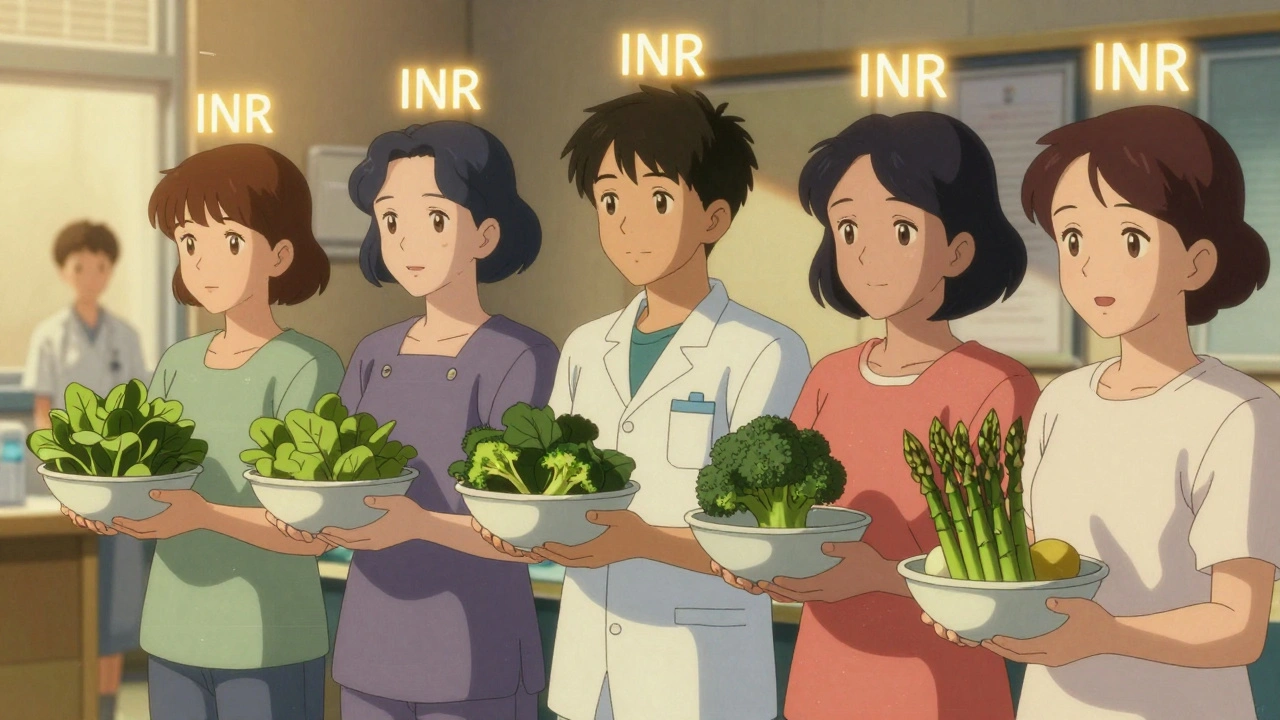
Not all greens are created equal. Some are packed with vitamin K, others barely register. Here’s what you need to know:- Cooked spinach: 889 µg per cup
- Cooked kale: 547 µg per cup
- Cooked collard greens: 772 µg per cup
- Cooked broccoli: 220 µg per cup
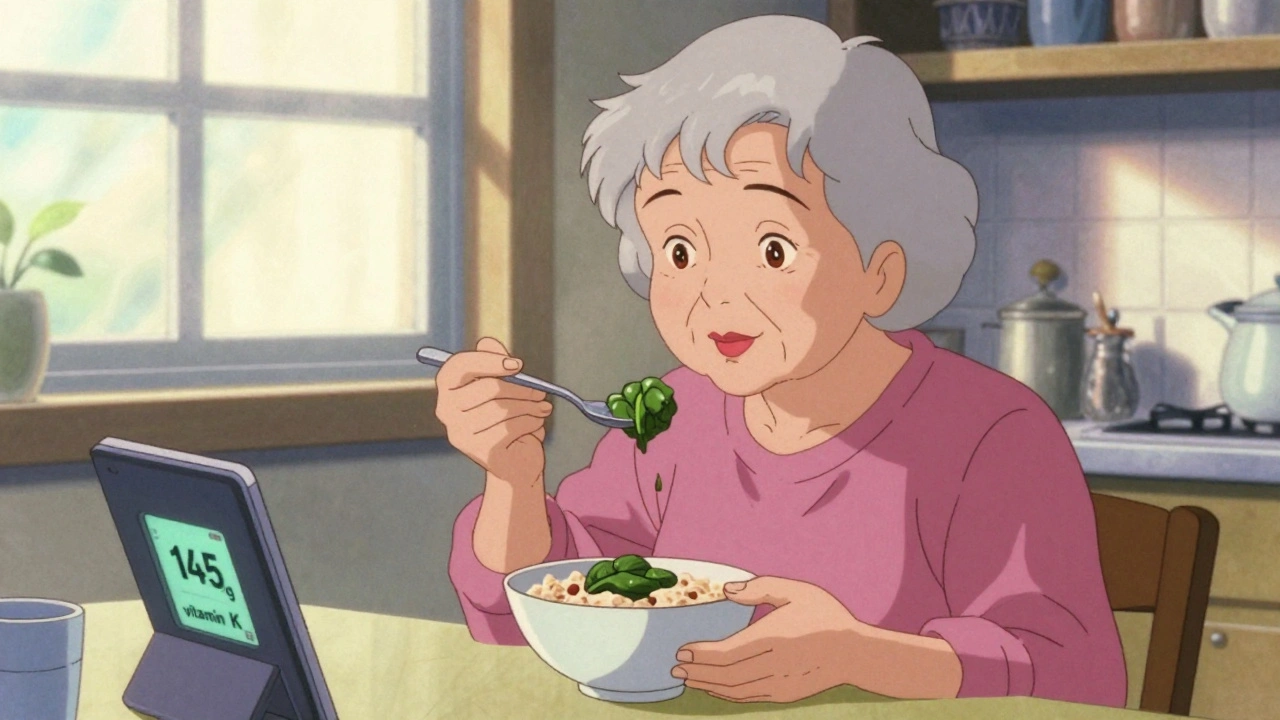
- Raw spinach: 145 µg per cup
- Asparagus: 70 µg per half-cup
- Green beans: 14 µg per half-cup
Notice something? Cooking spinach concentrates vitamin K. One cup of cooked spinach has more than six times the vitamin K of raw spinach. That’s why people who switch from raw salads to sautéed greens without realizing it often see their INR crash.
Other sources include Brussels sprouts, cabbage, parsley, and certain oils like soybean and canola. Even some supplements-like Ensure® and Boost® meal shakes-contain 50-55 µg per serving. And don’t forget about fermented foods like natto (a Japanese soy product), which is loaded with vitamin K2 and can be extremely potent.
What Consistency Actually Looks Like
Consistency doesn’t mean eating the same food every day. It means keeping your total vitamin K intake within a narrow range.One patient, a 71-year-old woman from Ohio, tracked her intake for six months. She ate one cup of raw spinach (about 145 µg) every morning with her oatmeal. On weekends, she swapped it for one cup of cooked broccoli (220 µg). Her vitamin K intake varied between 145-220 µg daily. Her INR stayed between 2.1 and 2.7-perfectly stable.
Another patient, a 64-year-old man from Michigan, ate kale salad three times a week. He’d eat three cups in one sitting (over 1,600 µg). Then he’d go days without any greens. His INR dropped to 1.8 after the salad, then shot up to 4.1 a few days later. He ended up in the ER twice.
The rule of thumb? Keep your daily vitamin K intake within 20% of your average. If you normally eat 100 µg per day, don’t suddenly eat 200 µg or drop to 30 µg. That’s the sweet spot for stability.

What About Restricting Vitamin K?
You’ve probably heard doctors say, “Avoid green vegetables.” That advice is outdated-and dangerous.Patients who try to cut out vitamin K entirely often end up with wild INR swings. Why? Because they eat something green by accident-a bite of salad at a restaurant, a spoonful of pesto-and their body reacts violently. One study found that patients who avoided vitamin K had more INR fluctuations than those who ate it consistently.
There’s one exception: if your INR is wildly unstable despite perfect medication adherence, your doctor might suggest lowering your intake to under 70 µg per day. But that’s a last resort. Most people stabilize better by eating a steady amount than by trying to avoid it altogether.
Even more surprising? Some studies show that taking a daily 100-150 µg vitamin K supplement can actually improve INR stability. It sounds backwards, but your body gets used to a steady supply, and the swings disappear.
What Else Can Throw Off Your INR?
It’s not just food. Many things can affect how warfarin works:- Antibiotics: Can kill gut bacteria that make vitamin K2. This can cause your INR to rise unexpectedly-even if your diet hasn’t changed.
- Illness: If you’re sick and not eating, your INR can spike. The WARFARIN-ILLNESS trial showed a 0.3-0.6 INR increase within 48 hours of reduced food intake.
- Alcohol: Heavy drinking can raise INR. Even moderate amounts on a regular basis can interfere.
- New medications: Over-the-counter painkillers like ibuprofen, some herbal supplements (like ginkgo or garlic), and even certain antidepressants can interact.
That’s why it’s so important to tell every doctor, pharmacist, or nurse you see that you’re on warfarin-even if they don’t ask.
How to Make It Easier
Managing vitamin K intake sounds overwhelming. But you don’t need to memorize numbers. Here’s how real people do it:- Choose one go-to high-K food: Pick one-like spinach, broccoli, or kale-and eat the same portion every day. That’s it.
- Use a food tracker: Apps like MyFitnessPal or CoumaDiet let you log meals and show vitamin K content. One study found patients using these apps improved their time in range by over 12%.
- Meal prep weekly: Cook your greens on Sunday and portion them out. No surprises during the week.
- Keep a food diary: Even just writing down what you ate each day helps you spot patterns. Anticoagulation clinics say 89% of stable patients keep some kind of log.
- Check your supplements: Multivitamins, protein shakes, and even some calcium supplements contain hidden vitamin K. Read labels.
It takes time. Most people need 8-12 weeks to get into a rhythm. But after that, it becomes second nature. One man from Seattle told his nurse, “I used to panic every time I saw a green vegetable. Now I just grab my daily spinach and move on.”
What If You Eat Too Much by Accident?
You had a big salad. You ate three cups of kale. You feel fine. What now?Don’t panic. Don’t skip your warfarin. Don’t try to “fix” it by eating less the next day.
Just call your anticoagulation clinic. They’ll likely want to check your INR in a few days. One high intake won’t cause a clot overnight-it takes time for your body to process it. But if you keep doing it, your INR will drop, and your risk of clotting goes up.
And if you forget and eat something high in vitamin K? Don’t beat yourself up. Everyone does it. What matters is getting back to your routine the next day.
Why Warfarin Is Still Used
Newer blood thinners like apixaban and rivaroxaban don’t need dietary tracking. So why is warfarin still prescribed to 35% of new atrial fibrillation patients in 2025?Because it’s cheap. Generic warfarin costs $4-$10 a month. The newer drugs cost over $3,000 a year. It’s also the only one with a proven, fast-acting antidote (vitamin K and fresh frozen plasma) if you bleed too much.
And here’s the kicker: when patients are educated properly, warfarin works just as well as the expensive options. The problem isn’t the drug-it’s the outdated advice.
Final Thought: You’re Not Alone
Thousands of people are managing warfarin with vitamin K every day. They’re not eating bland diets. They’re eating spinach, broccoli, and kale-just the same amount, every day. They’re traveling, cooking, dining out, and living full lives.You don’t need to give up your favorite foods. You just need to make them predictable.
Consistency isn’t about perfection. It’s about showing up. Every day.




Ada Maklagina
December 6, 2025 AT 01:20Just eat the spinach every day. No big deal. I do it with my eggs and I never think about it anymore.
Done.
Manish Shankar
December 6, 2025 AT 22:56Thank you for this meticulously researched and clinically grounded exposition. The distinction between restriction and consistency is not merely semantic-it is therapeutically paramount. I have observed in my practice that patients who adopt structured dietary routines exhibit markedly improved INR stability, irrespective of the absolute quantity of vitamin K consumed. The psychological burden of dietary fear is often greater than the physiological risk of moderate fluctuation.
Harry Nguyen
December 8, 2025 AT 14:01So let me get this straight-you’re telling me I can’t just eat a big-ass kale salad on Sunday like a normal human being without some lab tech calling me to ask if I’m trying to die?
And you want me to track this like I’m on a Weight Watchers diet for broccoli?
Meanwhile the new drugs cost $3000 a month and don’t care if I eat a whole damn head of cabbage.
Thanks for making warfarin the world’s most complicated diet plan.
Katie Allan
December 8, 2025 AT 17:58This is one of the most compassionate, clear-headed pieces on anticoagulation I’ve read in years.
It’s not about fear. It’s about rhythm. Like breathing. Like sleep. Like showing up for yourself, even when it feels tedious.
There is dignity in consistency. And there is life in routine.
You’re not being asked to give up your food-you’re being invited to own it, intentionally.
Thank you for writing this.
James Moore
December 10, 2025 AT 16:24Let’s be absolutely clear here: the entire medical-industrial complex is built on the illusion of control-when in reality, the body is a chaotic, adaptive system that responds not to rigid rules but to patterns, rhythms, and bioindividuality. The notion that a fixed microgram range of vitamin K is universally optimal is a statistical artifact, not a biological truth. One person’s 100µg is another’s 300µg-and yet we reduce complex physiology to a single number on a lab report, then shame people for ‘noncompliance.’ Meanwhile, the real issue-pharmaceutical monopolies, insurance gatekeeping, and the erasure of patient autonomy-is buried under a mountain of pamphlets about spinach.
Kylee Gregory
December 11, 2025 AT 10:22I appreciate how this post reframes the conversation from restriction to harmony. It’s not about avoiding greens-it’s about honoring your body’s need for predictability. I used to stress over every bite until I started meal-prepping my kale with my tofu on Sundays. Now it’s just… part of the rhythm. Like brushing my teeth. No guilt. No panic. Just steady.
And honestly? My INR hasn’t been this stable in five years.
Laura Saye
December 12, 2025 AT 22:41The pharmacokinetic interplay between gut microbiota and vitamin K2 metabolism is often underappreciated in clinical counseling. The enterohepatic recirculation of menaquinones, particularly those derived from fermented sources such as natto, exerts a prolonged anticoagulant modulation that may not be captured by standard dietary recall tools. Consequently, patients who consume intermittent but high-dose K2 may exhibit delayed INR fluctuations that correlate poorly with acute intake logs. This underscores the necessity of longitudinal biomarker tracking rather than reliance on episodic dietary reporting.
Carole Nkosi
December 14, 2025 AT 20:30Why do we still tolerate this archaic system? Warfarin is a 1940s drug with a 1940s management protocol. We have apps that can scan your food and auto-calculate vitamin K content. We have AI that predicts INR drift. But no-instead, we make people log their broccoli like it’s a religious ritual. And then we wonder why they give up. This isn’t medicine. It’s punishment disguised as precision.
Stephanie Bodde
December 16, 2025 AT 04:04You got this. Seriously. I started with zero idea what vitamin K even was. Now I have a little spinach cup in my fridge labeled ‘My Warfarin Buddy.’ It’s not perfect. Some days I forget. But I always come back. And that’s enough. You’re not alone. I’m rooting for you. 💪
luke newton
December 16, 2025 AT 09:16People who eat kale every day are just weak. Real men eat steak and don’t care about some leafy green conspiracy. You think your INR’s unstable? Try living in a country where they don’t even have spinach. You think you’re tough? You’re not. You’re just scared of your own plate.
William Chin
December 17, 2025 AT 06:13It is imperative to underscore that the aforementioned dietary consistency protocol must be implemented under the direct supervision of a certified anticoagulation management service. Self-regulation without laboratory validation constitutes a breach of clinical safety standards. Furthermore, the suggestion that supplementation may stabilize INR remains investigational and should not be construed as standard of care without prospective randomized controlled trial evidence.
Philip Kristy Wijaya
December 18, 2025 AT 04:38You people are ridiculous. You think you’re so smart because you eat spinach every day like some kind of vitamin K monk? What if I don’t want to eat greens? What if I like my steak rare and my salad on the side? Why should I have to turn my life into a spreadsheet just because some doctor thinks I’m too dumb to handle my own blood? You know what fixes warfarin? Not spinach. Not apps. Not logs. It’s the fact that we’re still using a drug that’s older than most of your parents. That’s the real problem. Not my diet.
Chris Brown
December 18, 2025 AT 21:04There is a moral failure here. A profound one. We have turned a life-saving medication into a test of obedience. We demand ritualistic adherence to a dietary code that even the doctors who prescribe it don’t fully understand. We shame patients for eating a single bite of broccoli on a weekend. We call it ‘stability’-but it’s control. And control is not care. Care is trust. Care is respect. Care is acknowledging that a human being is more than a number on a lab report. This post? It’s the exception. The rest of medicine? It’s a prison.