
Most people think drug patents last 20 years. That’s what you hear on TV, in news headlines, even from your pharmacist. But if you’ve ever waited for a brand-name drug to go generic, you know the real story is messier. A 20-year patent doesn’t mean 20 years of monopoly. In fact, most drugs lose their exclusive market protection in just 7 to 12 years after hitting the shelves. Why? Because the clock starts ticking before the drug even gets approved.
The 20-Year Clock Starts at Filing, Not Approval
The U.S. patent system gives drugmakers 20 years of protection from the day they file the patent application. That’s not when the drug is tested on humans. Not when it gets FDA approval. Not even when it hits pharmacy shelves. It’s when the paperwork gets stamped by the USPTO. And that paperwork? It usually gets filed during early-stage clinical trials - often 10 to 12 years before the drug is ready to sell.
Imagine you’re developing a new blood pressure pill. You file your patent in 2015. It takes six years to run clinical trials, get safety data, and submit it to the FDA. The FDA takes another three years to review it. You finally get approval in 2024. That means you’ve already used up nine years of your 20-year patent. You only have 11 years left - if you’re lucky. Most get less.
Patent Term Adjustment: When the Government Is Late
The USPTO doesn’t always move fast. If they take more than 14 months to give you your first review, or more than three years to issue the patent, you get extra time added back. This is called Patent Term Adjustment (PTA). It’s not automatic - you have to ask for it - and it’s calculated based on delays caused by the agency, not by you.
For example, if the USPTO took four years to approve your patent instead of three, you might get 12 months added to your term. That sounds helpful, but it’s rarely enough to make up for lost time. Most drugs still end up with only 7-12 years of actual market exclusivity after approval, even with PTA.
Patent Term Extension: The Hatch-Waxman Lifeline
In 1984, Congress passed the Hatch-Waxman Act to balance two things: protecting innovation and getting cheap generics to market faster. One part of that law lets drug companies apply for up to five extra years of patent protection to make up for time lost during FDA review.
But there’s a catch. The total time a drug can be protected - patent plus regulatory exclusivity - can’t exceed 14 years from the date of FDA approval. So if your drug got approved in 2020 and you got the full five-year extension, your patent would expire in 2034. But if your original patent was filed in 2010, the 20-year term ends in 2030. So you only get to extend to 2030, not 2034. The law caps it.
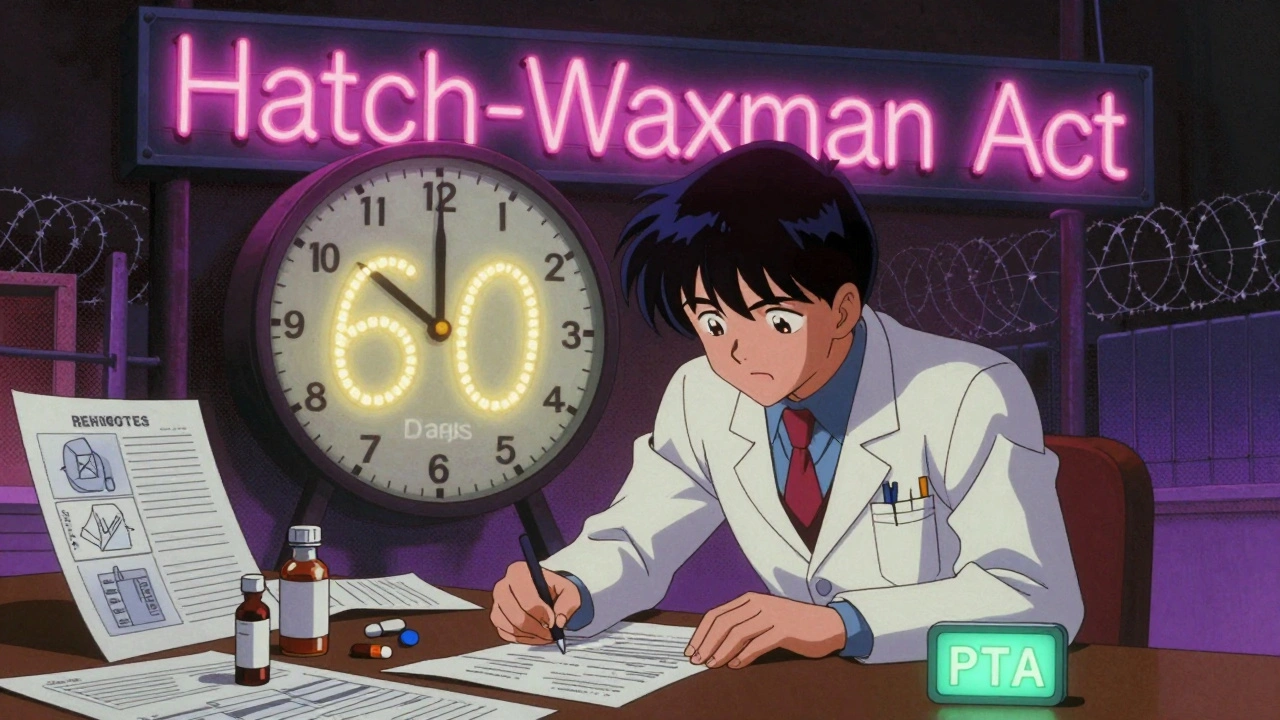
And here’s another kicker: you have just 60 days after FDA approval to apply for this extension. Miss it? You lose it. No second chances. Many small biotech firms miss this deadline because they’re overwhelmed with regulatory paperwork.
It’s Not Just One Patent - It’s a Stack
Big pharma doesn’t rely on one patent. They build a wall of them. A single drug like Humira (adalimumab) had over 130 patents covering everything from the active ingredient to how it’s packaged, how it’s injected, and even the software used to track doses.
There are:
- Compound patents - protect the actual molecule
- Formulation patents - protect how the drug is made (tablet, liquid, patch)
- Method-of-use patents - protect new ways to use the drug (e.g., treating rheumatoid arthritis instead of just psoriasis)
- Manufacturing process patents - protect how the drug is produced
Each one has its own 20-year clock. So even if the main compound patent expires in 2025, a formulation patent might hold out until 2028. That’s why some drugs don’t see generics for years after the “main” patent expires. This strategy is called “patent thickets,” and it’s standard practice.
Regulatory Exclusivity: The Secret Shield
Even if a patent expires, the FDA might still block generics. That’s because of regulatory exclusivity - separate from patents, and often more powerful.
- New Chemical Entity (NCE) Exclusivity: 5 years. No generic can even be submitted to the FDA during this time.
- Orphan Drug Exclusivity: 7 years for drugs treating rare diseases (fewer than 200,000 U.S. patients).
- New Clinical Investigation Exclusivity: 3 years for new uses or dosages that require new clinical trials.
- Pediatric Exclusivity: 6 months added to any existing exclusivity if the company does extra studies in kids.
Take Eliquis (apixaban). Its main patent expired in December 2022. But because it had NCE exclusivity, generics couldn’t even be filed until 2023. Then, a pediatric exclusivity extension pushed the earliest possible generic launch to June 2024. So even though the patent was gone, the market stayed protected for another 18 months.
The Patent Cliff: What Happens When It Hits
When exclusivity ends, prices don’t just drop - they crater. For small molecule drugs (pills and injections), generic versions typically capture 80-95% of the market within two years. The average price falls 60-80% in the first year.
In 2022, after Eliquis lost protection, generic apixaban hit the market. Within six months, generics had 35% of sales. By 18 months, they had 90%. The brand-name version’s price dropped 62% in the first year.
But it’s not always that simple. Biologics - complex drugs made from living cells, like Humira or Enbrel - face slower generic entry. These are called biosimilars, and they take longer to develop, get approved, and gain trust. They usually capture only 40-60% of the market after five years.
What’s Changing Now?
The system is under pressure. In 2024, Congress introduced the “Restoring the America Invents Act,” which could cut patent term adjustments by 6-9 months. The USPTO is also automating PTA calculations, which might reduce delays but could also reduce extensions.
Meanwhile, the World Health Organization is pushing for global patent terms to be shortened to 15 years to improve access to medicines. The pharmaceutical industry fights back, saying the average cost to develop a new drug is $2.3 billion - and they need every day of protection to recoup that.
One trend is clear: companies are stacking more patents, combining drugs, and creating “hybrid” products to delay competition. AstraZeneca’s Tagrisso, for example, still has patent protection until 2033 - even though its core molecule’s patent expired in 2026. How? They added new uses and delivery methods, each with its own patent.
What This Means for You
If you’re a patient, you might be paying more than you need to. Many people don’t realize their insurance switches from brand to generic months after the patent expires - but before the FDA allows it. Some insurers even force you to pay more for the brand during the 6-month pediatric exclusivity window, even though the patent is gone.
If you’re a caregiver or someone managing chronic medication, track your drug’s patent status. Use the FDA’s Orange Book - it’s free, public, and lists every patent tied to a brand-name drug. You can see exactly when exclusivity ends. That’s when you’ll start seeing lower prices.
And if you’re wondering why your drug hasn’t gone generic yet - it’s not because the company is holding out. It’s because the system is designed to protect them. The 20-year patent is just the starting point. The real clock? It’s a maze of extensions, exclusivities, and lawsuits.
Do all drug patents expire after exactly 20 years?
No. The 20-year term starts when the patent is filed, not when the drug is approved. Most drugs are on the market for only 7-12 years before generics can enter. Extensions like Patent Term Extension (PTE) or regulatory exclusivity can extend protection, but the total market exclusivity can’t exceed 14 years from FDA approval.
Why do some drugs still cost a lot even after their patent expires?
Because other protections may still be in place. Regulatory exclusivity - like 5-year NCE exclusivity or 6-month pediatric exclusivity - can block generics even after the patent ends. Also, some companies use patent thickets: filing dozens of secondary patents on delivery methods, formulations, or new uses to delay competition.
Can generic drugs enter before the patent expires?
Yes, but only if they challenge the patent. Under the Hatch-Waxman Act, a generic company can file an “ANDA” with a Paragraph IV certification, claiming the patent is invalid or won’t be infringed. This triggers a 30-month stay on FDA approval while lawsuits play out. If the generic wins, they can launch early - and get 180 days of exclusive generic rights.
What’s the difference between a patent and regulatory exclusivity?
A patent is a legal right granted by the USPTO to protect invention. Regulatory exclusivity is a government promise from the FDA not to approve generics for a set time, regardless of patents. You can have exclusivity without a patent, and vice versa. Exclusivity often lasts longer and is harder to challenge.
How do I find out when my drug’s patent expires?
Go to the FDA’s Orange Book (https://www.accessdata.fda.gov/scripts/cder/ob/). Search by brand name. It lists every patent and exclusivity period tied to the drug. Look for the “Expiration Date” column - that’s when generics can legally launch. Don’t trust pharmacy websites - they’re often outdated.
Why do some biosimilars take longer to appear than generics?
Biosimilars are copies of complex biologic drugs made from living cells - not simple chemicals. They require more testing, longer approval times, and face more legal hurdles. They also need to prove they’re “interchangeable” with the original, which the FDA only grants after extra studies. That’s why it can take 5-10 years for biosimilars to reach 50% market share, while generics hit 90% in 18 months.

Wendy Chiridza
December 2, 2025 AT 23:43Wow this is such a clear breakdown I didn't realize the clock starts ticking before approval
I've been paying for brand-name insulin for years thinking the patent was still active but turns out it was the regulatory exclusivity holding things up
Thanks for explaining the Orange Book too I just checked mine and the expiration is next month
Erik van Hees
December 3, 2025 AT 03:24Actually the 20-year patent term is a total scam
Big pharma files patents when the drug is just an idea in a lab then sits on it for 10 years while the FDA drags its feet
Then they cry about needing protection when they've already had 15 years of de facto monopoly before the drug even hits shelves
And don't get me started on patent thickets
One molecule 130 patents
That's not innovation that's legal gymnastics
And the Hatch-Waxman Act was supposed to fix this
Now it's just a tool for them to extend monopolies
Meanwhile my co-pay is still $400 for a pill that costs 50 cents to make
And you wonder why people go to Canada for meds
Pamela Mae Ibabao
December 3, 2025 AT 23:43Okay but let's be real
Would you want your life-saving drug to be developed by a company that knows it only has 5 years to make back $2.3 billion
That's the brutal math
Without these extensions and thickets no one would bother
It's not greed it's survival
And yes the system is broken but fixing it means fewer new drugs
That's the tradeoff nobody wants to admit
I'm not saying it's fair
I'm saying it's necessary
Would you rather have no new cancer drugs or pay $500 a month for one that works
Palanivelu Sivanathan
December 5, 2025 AT 14:02OMG
THIS IS SO DEEP
Like literally the entire pharmaceutical industry is built on a lie
20 years??
HA
More like 7-12
And the patent thickets??
It's like they're building a fortress out of legal duct tape
And the FDA??
They're just sitting there like a sleepy librarian
Meanwhile my grandma is crying because she can't afford her blood thinner
And we're all just... letting this happen??
Someone call the police
Or at least a protest
Where are the marches??
Joanne Rencher
December 6, 2025 AT 01:28So basically we're being scammed by lawyers and bureaucrats
Great
And the worst part?
No one cares
Everyone's too busy scrolling TikTok to realize their meds are priced like luxury handbags
Just another day in America
Mark Gallagher
December 6, 2025 AT 06:44Stop acting like this is some conspiracy
Patents are a legal contract
They're not a moral obligation
If you want cheaper drugs go to India
Or Canada
Or anywhere else
But don't blame the system
It's working exactly as designed
And if you think generics are always better
Try switching from Eliquis to a generic and tell me your INR levels stay stable
Some of us have lived through the consequences
So spare me the outrage
It's not that simple
Siddharth Notani
December 7, 2025 AT 23:41Respectfully, the concept of patent term adjustment is rooted in the principle of equitable compensation under 35 U.S.C. § 154(b)
The USPTO's delays are quantifiable and legally mandated to be compensated
However, the cumulative effect of PTA, PTE, and regulatory exclusivity does create an unintended monopolistic extension beyond the statutory intent
Further, the Hatch-Waxman Act's 14-year cap is often misunderstood
It caps the sum of patent life and regulatory exclusivity from FDA approval date, not the total patent term
Therefore, the 20-year clock remains intact, but market exclusivity is truncated
For precise analysis, consult the FDA Orange Book's Exclusivity Expiration column
Gerald Nauschnegg
December 9, 2025 AT 06:41Y'all are missing the point
Look at Humira
It's been on the market since 2002
And guess what?
It still has patents until 2026
How?
Because they keep filing new ones for the injector pen
And the app
And the storage temp
And the packaging
It's like they're patenting the color of the box
And the FDA lets them
And Congress doesn't care
And patients are stuck paying $7,000 a month
THIS IS NOT HEALTHCARE
THIS IS CORPORATE ROBBERY
Cristy Magdalena
December 10, 2025 AT 07:32I just found out my dad's medication won't go generic until next year
And he's been taking it for 12 years
And now we're being told it's because of some 6-month pediatric exclusivity
But he doesn't have kids
So why are we paying for someone else's child's research?
I'm not angry
I'm heartbroken
And tired
And I just want him to be able to breathe without selling his house
Chad Kennedy
December 11, 2025 AT 12:33So what you're saying is
the whole system is rigged
and we're all just pawns
and the only ones winning are the CEOs
and the lawyers
and the shareholders
and we're left with bills we can't pay
and no one to blame
except maybe ourselves
for not voting
or protesting
or doing anything
except scrolling
Adrianna Alfano
December 11, 2025 AT 20:59I'm from India and I've seen how this plays out
My cousin in Delhi gets the same drug for $12 because it's generic there
But in the US? $600
And I just cried
Not because I'm mad
But because I realized
we're all being treated like numbers
not people
and the system doesn't care if you live or die
as long as the profit margin stays high
and I just want someone to fix this
but I don't know how
dylan dowsett
December 11, 2025 AT 22:08And you think this is bad? Wait until you see what happens when biosimilars hit the market
They're going to be even more expensive than the originals
Because the manufacturing is so complex
And the regulatory hurdles are insane
And the lawsuits will last a decade
So don't get your hopes up
Generics are already a myth
And biosimilars? They're just a new kind of scam
with more paperwork