

Most people take melatonin at the wrong time. They pop a pill 30 minutes before bed, hoping it’ll knock them out - and then wonder why they’re still wide awake, or worse, groggy all morning. The truth? Melatonin isn’t a sleeping pill. It’s a signal. It tells your body it’s time to shift into sleep mode. Get the timing wrong, and you’re not just wasting money - you’re messing with your internal clock.
How Melatonin Really Works
Your body makes melatonin naturally when it gets dark. The pineal gland releases it slowly after sunset, peaking around 2-4 a.m., then dropping off as morning light hits your eyes. That’s your rhythm. Synthetic melatonin doesn’t force sleep. It just nudges your internal clock forward or backward - like resetting a watch. The problem? Most supplements are poorly labeled. A 3 mg tablet might be fast-release, slow-release, or a mix. The formulation changes everything. Fast-release hits your bloodstream in 30-60 minutes and fades in 4-6 hours. Slow-release spreads the dose out over 6-8 hours, mimicking your body’s natural overnight release. A 2024 meta-analysis of 27 studies with over 2,400 people found that melatonin’s sweet spot for falling asleep faster is 4 mg - not the 1-2 mg most people start with. But here’s the twist: that 4 mg dose only works if you take it three hours before you want to sleep. Not 30 minutes. Not one hour. Three hours.The Dose Confusion: Why 1 mg, 3 mg, or 10 mg?
There’s no universal dose. It depends on your goal, your body, and your sleep history.- For beginners: Start with 0.5 mg. Seriously. Most people don’t need more. A 2024 Sleep Foundation survey showed 62% of users felt better on 1 mg or less.
- For adults with insomnia: 1-3 mg is the typical range. The UK’s NHS recommends 2 mg slow-release, taken 1-2 hours before bed. But if you’ve tried that and it didn’t help, try 4 mg three hours before bedtime. The data says it works better.
- For jet lag: Stick to 1-3 mg fast-release. Slow-release can linger too long and confuse your clock. The Timeshifter protocol, based on flight direction and chronotype, shows this works best.
- Above 5 mg: You’re entering risk territory. Side effects like morning grogginess, vivid dreams, dizziness, and headaches jump sharply. One study found 37% of users over 5 mg reported next-day drowsiness.
- Above 10 mg: Not recommended unless under medical supervision. Higher doses can suppress your body’s own melatonin production - and that’s not something you want to mess with long-term.
Timing: Why 30 Minutes Is Often Too Late
The old advice - “take it 30 minutes before bed” - comes from a time when people assumed melatonin worked like a sedative. It doesn’t. It’s a circadian regulator. If you’re trying to fall asleep at 11 p.m., taking melatonin at 10:30 p.m. means your blood levels peak right when you’re already trying to sleep. But your body needs time to respond. Think of it like turning down the lights in your house before you go to bed - you don’t flip the switch the moment you crawl under the covers. For general sleep initiation, aim for 3-4 hours before your target bedtime. So if you want to sleep at 11 p.m., take it between 7 and 8 p.m. This gives your body time to respond to the signal and lower core temperature, which is key for sleep onset. But there’s an exception: long flights. If you’re on a 10-hour flight and plan to sleep during it, take 1-3 mg of fast-release melatonin 30-45 minutes before you want to nod off. That’s a situational use - not a daily habit.
Jet Lag Protocols: East vs. West, Fast vs. Slow
Jet lag isn’t just about being tired. It’s your body stuck in the wrong time zone. Melatonin helps you shift your rhythm, but the strategy changes depending on which way you fly. Eastward travel (e.g., Seattle to London): Your body is behind. You need to advance your clock. Take 1-3 mg fast-release melatonin at destination bedtime - even if it’s 1 a.m. your old time. Do this for 3-5 days. Avoid taking it after 4 a.m. local time - it can delay your reset. Westward travel (e.g., London to Seattle): Your body is ahead. You need to delay your clock. Here’s the trick: take melatonin in the morning at your destination - around 7-9 a.m. - to push your rhythm later. Some experts recommend skipping melatonin entirely and using bright light in the evening instead. But if you’re struggling, 1 mg in the morning can help. The NHS says 3 mg is fine for jet lag, but only for up to 5 days. Timeshifter, which tracks over 50,000 travelers, recommends no more than 3 mg - and only fast-release. Slow-release? Avoid it. It lingers and blurs the signal your brain needs to reset.Who Should Avoid Melatonin - And Who Needs More
Melatonin isn’t for everyone.- Children: Start with 0.5-1 mg. Most kids respond to low doses. The UC Davis Health team recommends increasing by 0.5 mg weekly if needed, maxing out at 2 mg for most. Never give melatonin to a child under 3 without a doctor’s input.
- People with autoimmune disorders: Melatonin can affect immune activity. Talk to your doctor before using it.
- People on blood thinners, diabetes meds, or antidepressants: Melatonin can interact. It’s not always dangerous, but you need to know the risks.
- Those with chronic sleep disorders (ADHD, cerebral palsy, chronic fatigue): The NHS allows up to 10 mg daily under specialist care. This isn’t for self-treatment. These cases need monitoring.
What to Look for in a Supplement
Not all melatonin is created equal. Since it’s sold as a supplement (not a drug), the FDA doesn’t regulate purity or dosage accuracy. A 2023 study found that 71% of over-the-counter melatonin products contained between 83% and 478% more melatonin than labeled. That’s huge. A bottle labeled “3 mg” could actually be 14 mg. Look for:- Third-party tested (USP, NSF, or ConsumerLab seal)
- Clear labeling: “fast-release” or “extended-release”
- No unnecessary fillers like sugar, artificial colors, or gluten if you’re sensitive
- Manufactured in the U.S. or EU - stricter standards than some other countries
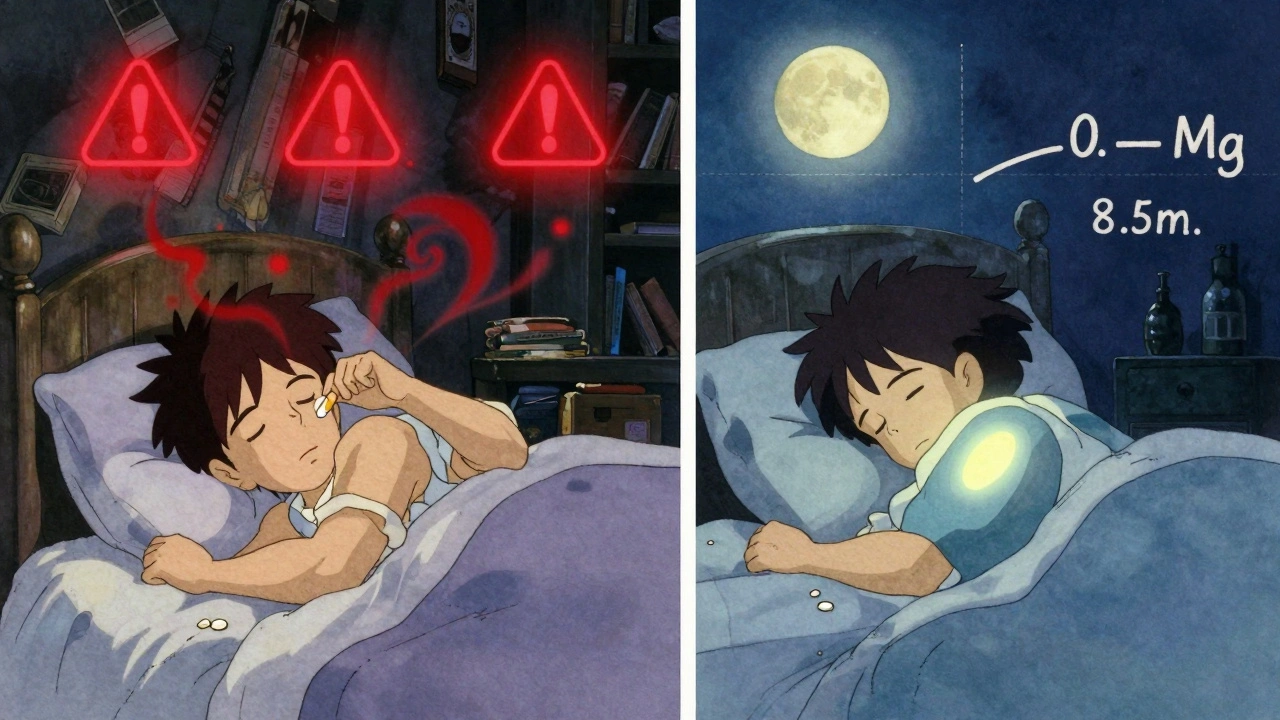
What Happens If You Take Too Much?
Taking 5 mg once? Probably fine. Taking 10 mg every night for weeks? You might start feeling off. Side effects of high doses:- Morning grogginess (37% of users over 5 mg)
- Vivid or weird dreams (common at 3 mg+, more frequent above 5 mg)
- Dizziness or nausea (8.7% and 6.3% higher risk above 5 mg)
- Headaches (12.4% vs. 5.2% at lower doses)
- Disrupted natural rhythm - your body might stop making its own melatonin temporarily
When Melatonin Won’t Help - And What to Do Instead
Melatonin fixes timing problems. It doesn’t fix:- Stress-induced insomnia
- Restless legs syndrome
- Obstructive sleep apnea
- Chronic anxiety
- Get 15-30 minutes of morning sunlight - this resets your clock better than any pill
- Turn off screens 90 minutes before bed - blue light blocks natural melatonin
- Keep your bedroom cool (60-67°F) - your core temp must drop to sleep
- Go to bed and wake up at the same time every day - even on weekends
Final Rule: Less Is More
You don’t need a high dose. You don’t need to take it right before bed. You just need to take it at the right time - with the right formulation - and give your body space to respond. Start low. Wait three hours. Use fast-release for jet lag. Avoid slow-release unless you’re treating chronic insomnia under medical guidance. And if you’re still struggling after a few weeks? Talk to a sleep specialist. Melatonin isn’t the answer to everything - but when used right, it’s one of the most powerful tools we have for fixing broken rhythms.Can I take melatonin every night?
Yes, for short-term use - up to 13 weeks according to NHS guidelines. But long-term nightly use isn’t recommended unless you have a diagnosed circadian disorder. It’s best used as a reset tool, not a daily crutch. If you’re still needing it after 2-3 months, see a sleep specialist.
Is 10 mg of melatonin safe?
10 mg is not recommended for general use. It’s only used under specialist supervision for rare conditions like ADHD or cerebral palsy in children. For most adults, 5 mg is the upper limit. Higher doses increase side effects and can disrupt your natural melatonin production. Stick to 1-4 mg unless your doctor says otherwise.
Should I take melatonin before or after eating?
Take it on an empty stomach or with a light snack. Heavy meals can delay absorption. Avoid alcohol - it interferes with melatonin’s effectiveness and worsens next-day grogginess. If you’re taking it for jet lag on a flight, take it after your last meal.
What’s the difference between fast-release and slow-release melatonin?
Fast-release hits your system quickly - ideal for jet lag or falling asleep fast. Slow-release spreads the dose over 6-8 hours, mimicking your body’s natural overnight release - better for staying asleep. Use fast-release for timing shifts, slow-release for staying asleep through the night.
Can melatonin help with shift work sleep disorder?
Yes. If you work nights and sleep during the day, taking melatonin 30-60 minutes before your daytime sleep can help. But you’ll also need blackout curtains, white noise, and strict sleep scheduling. Melatonin alone won’t fix it - it just helps your body accept the new schedule.
Does melatonin cause weight gain?
No direct link exists. But poor sleep - which melatonin is meant to fix - can lead to weight gain by increasing hunger hormones. If you’re gaining weight while taking melatonin, it’s likely due to other factors like diet, stress, or lack of movement - not the supplement itself.
How long does melatonin stay in your system?
Melatonin’s half-life is only 20-50 minutes, meaning half of it clears from your blood in under an hour. But its effects on your circadian clock can last 4-8 hours, depending on dose and formulation. That’s why timing matters more than how long it’s detectable.
Can I take melatonin with alcohol?
Avoid it. Alcohol disrupts sleep architecture and reduces melatonin’s effectiveness. It also increases next-day drowsiness and dizziness. If you’re using melatonin to fix sleep, don’t sabotage it with alcohol.




Sheryl Lynn
December 1, 2025 AT 22:45Oh honey, you took the red pill and saw the matrix-melatonin isn’t a sleep potion, it’s a circadian symphony conductor. Most people treat it like a whiskey shot before bed, but no, darling, you’re not lighting a fuse-you’re tuning a Stradivarius. Three hours? Of course. You don’t blare the finale before the overture. Slow-release is for people who want to sleep like a sloth in a hammock. Fast-release? That’s the violinist who hits the high note exactly when the moon peaks. And please, for the love of circadian rhythm, stop buying those 10mg bottles labeled ‘natural’ that contain more filler than a Kardashian’s Instagram caption.
Paul Santos
December 2, 2025 AT 05:38Actually, the real issue here is the commodification of chronobiology. We’ve turned a neurohormonal signal into a Walmart aisle staple, and now everyone thinks they’re a sleep architect because they read a blog. 🤷♂️ The 4mg sweet spot? Valid. But let’s not forget: melatonin is a zeitgeber, not a hypnotic. You’re not ‘inducing’ sleep-you’re nudging the suprachiasmatic nucleus into alignment. And if you’re popping pills because your phone glows at midnight? That’s not a melatonin problem. That’s a cultural collapse. 😔
Eddy Kimani
December 3, 2025 AT 20:12Wait-so if fast-release peaks in 30-60 mins, and you take it 3 hours before bed, does that mean your melatonin levels are dropping by bedtime? Doesn’t that contradict the idea of helping you fall asleep? I get the circadian shift thing, but if your blood levels are already falling, how does that help initiation? Is it more about priming the hypothalamus to drop core temp earlier? Anyone have data on plasma concentration curves vs sleep latency at different timings? Asking for a friend who’s been up since 2 a.m. again.
Chelsea Moore
December 5, 2025 AT 02:42THIS. IS. WHY. WE. CAN’T. HAVE. NICE. THINGS.!! People take 10mg like it’s gummy vitamins and then wonder why they’re hallucinating about talking raccoons at 3 a.m.!! And don’t even get me started on the ‘slow-release’ junk-your body doesn’t need a 7-hour melatonin drip, it needs a gentle whisper, not a foghorn!! And what about the kids??!! Parents are giving this to 4-year-olds like it’s sugar pills!! This is not a supplement-it’s a hormonal grenade!!
John Biesecker
December 5, 2025 AT 05:34Man, I used to take 5mg every night… now I get 0.5mg at 7 p.m. and boom-sleep like a baby. 🌙✨ Turns out my brain wasn’t broken, it was just drowning in melatonin noise. Also, morning sunlight changed my life. I used to think it was just ‘sunshine vibes’ but now I know it’s resetting my SCN. Still mess up on weekends though… 😅
Genesis Rubi
December 6, 2025 AT 19:00USA made this article right. UK says 3mg fine? Nah. We know better. That’s why our sleep science is #1. You think Brits know what real jet lag is? They fly to Paris and call it ‘continental adjustment’. We fly from LA to Tokyo and reset our entire DNA. And yeah, you better buy USP-tested stuff. That Chinese junk? No thanks. I don’t need my pineal gland getting hacked by a factory in Guangdong.
Doug Hawk
December 7, 2025 AT 21:52Interesting breakdown. I’ve been using 1mg fast-release 3 hours before bed for 6 months now. No grogginess. No weird dreams. Just… sleep. I used to think it was placebo until I tracked my sleep with a WHOOP. My deep sleep jumped 22%. The key for me was consistency. Same time. Same dose. No alcohol. No screens. And yeah, I do skip it on weekends. Feels like giving my clock a vacation. Also-third-party tested? Yes. I only buy the ones with the NSF seal. No exceptions.
John Morrow
December 9, 2025 AT 01:33While the article presents a compelling framework, it fundamentally misunderstands the dose-response curve of melatonin in relation to MT1/MT2 receptor saturation kinetics. The 4mg threshold cited from the 2024 meta-analysis conflates mean efficacy with therapeutic optimum-ignoring interindividual variability in CYP1A2 metabolism and receptor density. Moreover, the assertion that slow-release is contraindicated for jet lag overlooks phase-response curve data from Zhdanova et al. (2023), which demonstrated that extended-release formulations produce more stable entrainment in phase-delay paradigms. The FDA’s lack of oversight is not merely a regulatory failure-it’s a pharmacological catastrophe. And let’s not ignore the confounding variable of light exposure intensity: if you’re taking melatonin at 7 p.m. but your ambient lux is still 500, you’re essentially whispering into a hurricane.