
Topical Steroid Potency Selector
Recommended Strength
Low RiskFingertip Units Required
1-2 FTUs for face/neck, 2 FTUs for arms, 3 FTUs for legs
Potential Risks
- Minimal skin thinning risk
- Low risk of rebound flares
Using the wrong strength of topical steroid can thin your skin, cause redness, or even trigger a rebound flare that makes your condition worse. It’s not about using the strongest cream you can find-it’s about matching the right potency to your skin, your body, and how long you need to use it. Many people don’t realize that hydrocortisone from the drugstore and clobetasol from the pharmacy are on opposite ends of the same spectrum. One is mild enough for a baby’s diaper rash. The other can cause permanent damage if used carelessly.
What Does Steroid Potency Even Mean?
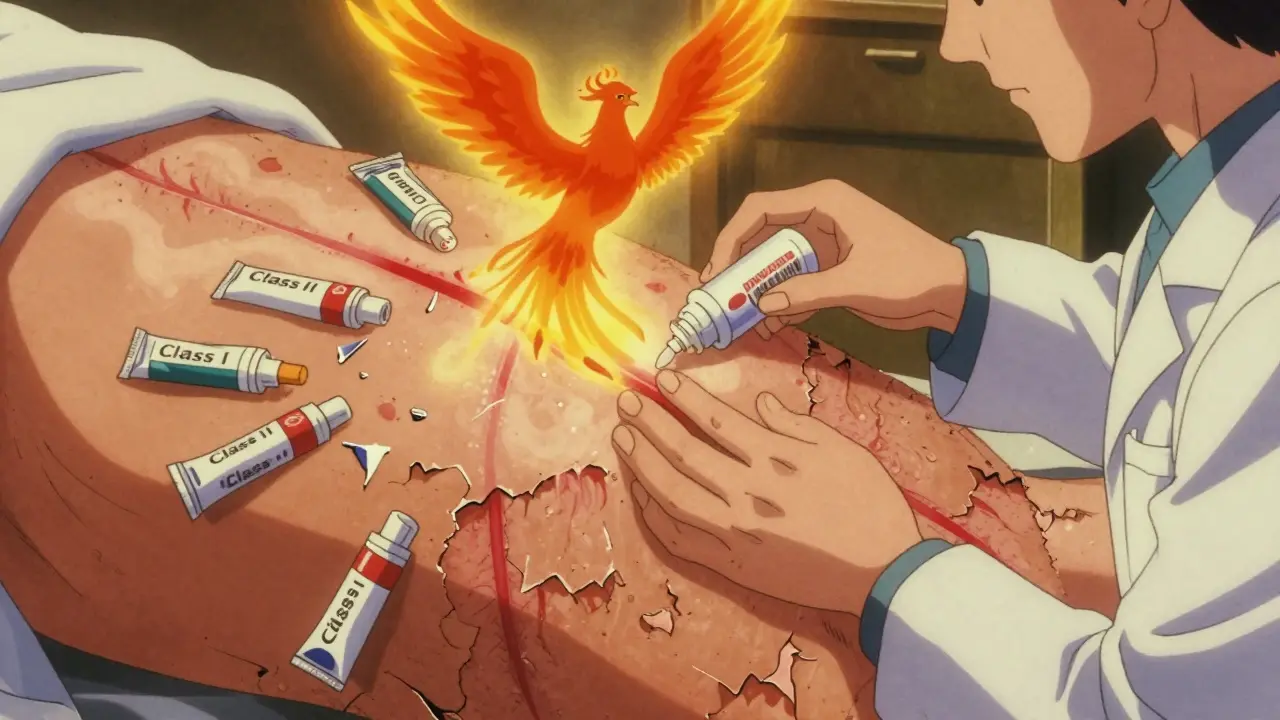
Potency isn’t just a label. It’s a measure of how strongly a steroid affects your skin’s blood vessels and immune response. Doctors test this using a simple but precise method: they apply the cream to a person’s skin and measure how much it whitens the area. The more it whitens, the more potent the steroid. This is called a vasoconstrictor assay. The results are grouped into classes. In the U.S., the FDA uses a seven-class system. Class I is the strongest-superpotent. Class VII is the weakest. Think of it like a ladder. Step on the wrong rung, and you could slip into trouble. Here’s what the top and bottom look like:- Class I (Superpotent): Clobetasol propionate 0.05%, halobetasol propionate 0.05%. Used for severe psoriasis or stubborn eczema. These are not for the face, groin, or kids.
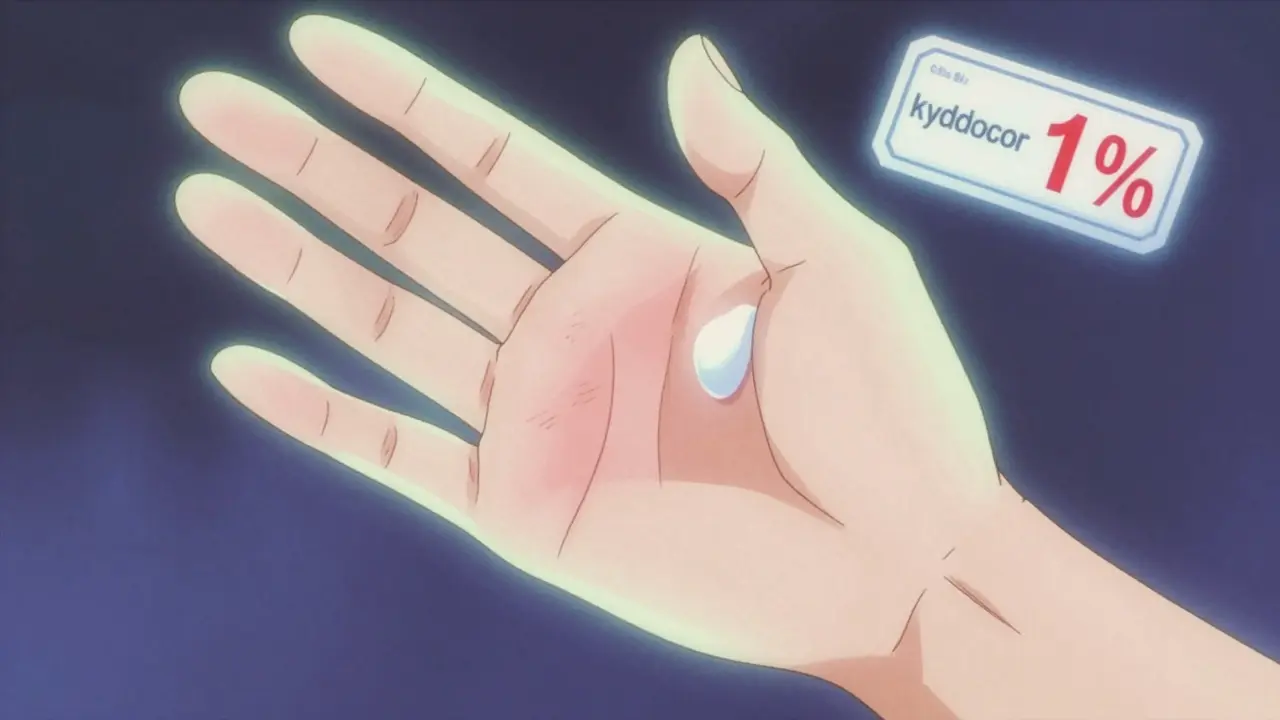
- Class VII (Least Potent): Hydrocortisone 0.1%-2.5%. Safe for short-term use on sensitive skin, even babies.
Why Your Skin Reacts Differently Based on Where You Apply It
Your skin isn’t the same everywhere. The skin on your eyelids is 10 times thinner than the skin on your back. Apply a Class III steroid to your face, and you risk visible blood vessels, stretch marks, or even acne. Use it on your palms? It might not do much at all. The Skin Health Institute of Australia tracks this in detail. They found that applying a steroid to skin folds-like under the breasts, armpits, or groin-makes it absorb up to one potency level higher. So if you’re using a moderate cream on your inner thigh, your body treats it like a potent one. That’s why doctors tell you to avoid strong steroids on those areas. It’s not a suggestion. It’s science. Even the base matters. Ointments are greasy. They seal in moisture and let more steroid soak in-about 15-20% more than creams. So if your doctor prescribes a Class IV ointment, it’s stronger than the same strength cream. Don’t assume they’re equal.The Real Risks of Using Steroids Too Long or Too Strong
Side effects aren’t rare. They’re predictable-and preventable.- Skin thinning: Seen in 29% of people who use Class I steroids for more than 3 weeks. Skin becomes translucent, bruises easily, and tears with minor trauma.
- Stretch marks: Permanent, especially on thighs, belly, or arms. Often starts as red lines, then turns white.
- Telangiectasia: Visible tiny blood vessels. Happens in 12% of people using Class II-III steroids for over 3 months.
- Rebound flares: When you stop the steroid, your skin explodes back worse than before. This is called topical steroid withdrawal. It affects 20-30% of people who misuse potent steroids long-term.
- Systemic effects: In kids, high-potency steroids can suppress the adrenal glands. One study found 8.7% of children on long-term strong steroids had signs of hormone disruption.
How Much Should You Actually Use? (The Fingertip Unit Rule)
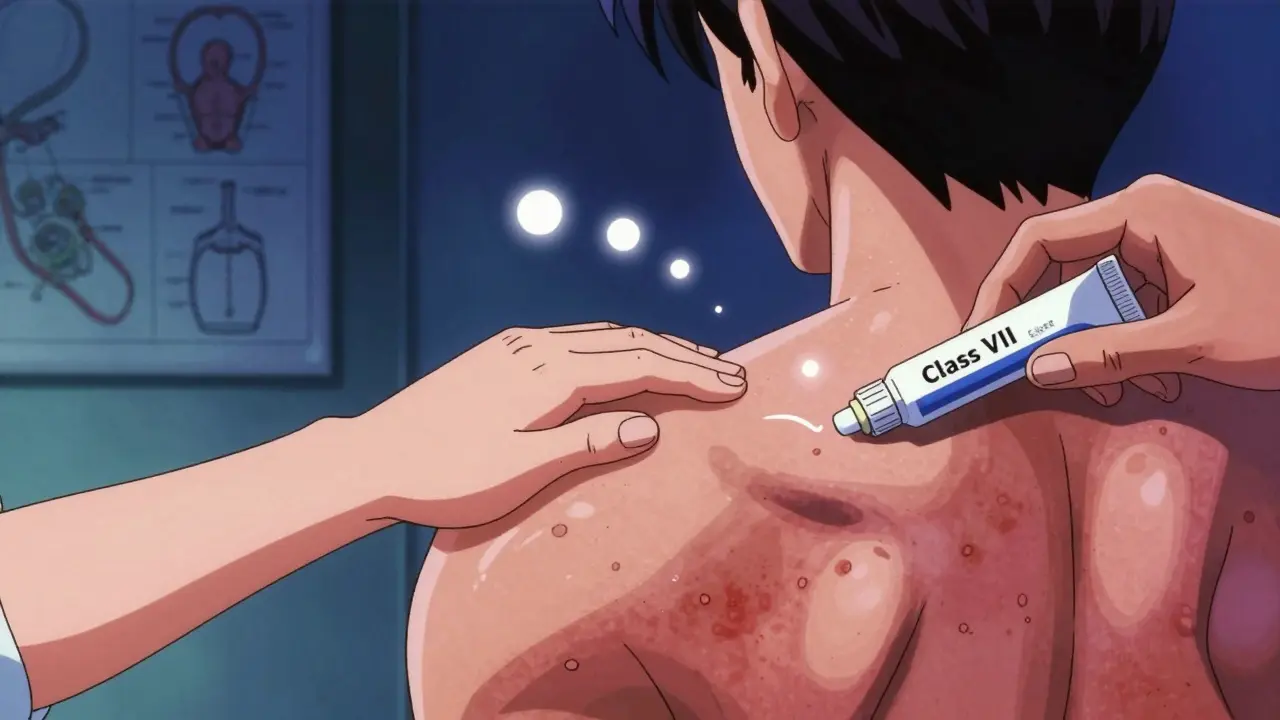
Most people use way too much. Studies show 35% of patients apply two to three times the recommended amount. That’s not just wasteful-it’s dangerous. The solution? The fingertip unit (FTU). One FTU is the amount of cream or ointment squeezed from a standard tube, from the first crease of your index finger to the tip. That’s about 0.5 grams. One FTU covers an area equal to two adult palms. Here’s how to use it:- Face and neck: 1-2 FTUs total
- One arm: 2 FTUs
- One leg: 3 FTUs
- Full back: 6 FTUs
Special Cases: Kids, Elderly, and Sensitive Skin
Kids aren’t small adults. Their skin absorbs steroids faster. Their body weight is lower. Their hormones are more sensitive. The American Academy of Pediatrics says: for children under 12, cut adult doses by 50-75%. Use only mild or moderate steroids. Never use Class I or II on kids unless under direct supervision. Even then, limit it to 7-14 days. Older adults? Their skin gets thinner with age. Same risk as kids. Use the lowest effective dose. Avoid long-term use. If your skin is cracked, bleeding, or weeping, that’s a compromised barrier. Studies show steroids absorb 40-50% more in damaged skin. That means a Class IV cream might act like a Class II. Be extra cautious. Talk to your dermatologist before applying anything.What About Newer Treatments? Steroid-Sparing Options
You don’t have to rely on steroids forever. New non-steroidal treatments are changing the game.- Crisaborole (Eucrisa): A topical PDE4 inhibitor. Safe for kids 2+ and face use. Less effective than potent steroids but no thinning risk.
- Ruxolitinib (Opzelura): A JAK inhibitor. Works well for plaque psoriasis and eczema. Clears 72% of cases in 4 weeks-slightly less than Class I steroids (85%), but safer for long-term use.
How to Use a Potency Chart Without Getting Confused
You don’t need to memorize every class. Just follow three rules:- Match strength to location: Face? Use mild. Scalp? Moderate. Back? Potent if needed.
- Match strength to age: Kids? Stick to mild or moderate. Never superpotent.
- Match duration to strength: Stronger = shorter time. Mild = longer use okay.
What to Do If You’ve Already Damaged Your Skin
If you’ve been using a strong steroid for months and now your skin is thin, red, or burning when you stop, you’re not alone. Topical steroid withdrawal is real. It’s not addiction. It’s your skin rebelling after being suppressed too long. The fix isn’t another steroid. It’s patience and support.- Stop the steroid cold turkey-no tapering. Tapering doesn’t work for withdrawal.
- Use gentle, fragrance-free moisturizers daily. Ceramide creams help rebuild the barrier.
- Keep skin cool. Heat and sweat make it worse.
- See a dermatologist. They can prescribe non-steroidal options to help during recovery.
Final Rule: Less Is More
The goal isn’t to kill the rash with the strongest weapon. It’s to calm it down with the mildest tool that works. Most flares respond to mild steroids. Most chronic cases need a mix of moisturizers, triggers avoidance, and smart steroid use-not brute force. Potency charts aren’t just for doctors. They’re for you. If you’re using a topical steroid, you deserve to know what you’re putting on your skin. And you deserve to know how to use it safely. The science is clear. The tools are available. The only thing left is to use them.Can I use a strong steroid on my face if I only use it for a few days?
No. Even short-term use of potent steroids (Class I-III) on the face can cause permanent damage like visible blood vessels, acne, or skin thinning. The skin on your face is thin and sensitive. Always use mild potency (Class VI-VII), like hydrocortisone 1%, and only for 3-5 days max. If it doesn’t improve, see a dermatologist.
Is hydrocortisone 2.5% stronger than hydrocortisone 1%?
Yes. Hydrocortisone 2.5% is in Class VII (least potent), but it’s stronger than the 1% version, which is also Class VII. Both are safe for short-term use on mild rashes, but the 2.5% version should still be limited to 7 days. Never use 2.5% on children under 2 or on the face without a doctor’s advice.
Why do some creams say ‘for eczema’ but others say ‘for psoriasis’?
It’s not the label-it’s the potency. Psoriasis often needs stronger steroids (Class I-II) because the skin is thick and inflamed. Eczema is usually treated with milder steroids (Class IV-VI) because the skin is fragile. Some products are formulated with specific bases for each condition, but the active ingredient’s strength matters more than the label. Always check the potency class, not just the intended use.
Can I use a steroid cream every day for months if my skin keeps coming back?
No. Continuous daily use of moderate to potent steroids for more than 3 months increases the risk of skin thinning, stretch marks, and rebound flares. Instead of daily use, try proactive therapy: apply a mild steroid twice a week to areas that flare often. This reduces flares by 68% without long-term damage. If your skin keeps returning, you need a different approach-like non-steroidal treatments or identifying triggers.
Are ointments stronger than creams with the same steroid?
Yes. Ointments are greasier and trap more moisture, letting more of the steroid absorb into your skin-up to 15-20% more than creams. So if you’re using a Class IV ointment, it’s effectively stronger than the same Class IV cream. If your skin is dry and cracked, ointments are better. If your skin is oily or sweaty, creams are less irritating.


Chris Buchanan
December 23, 2025 AT 16:54So let me get this straight-you’re telling me I’ve been slathering clobetasol on my face like it’s face cream because my acne was ‘acting up’? And now my skin looks like a roadmap of broken capillaries? Thanks for the wake-up call, OP. I’m literally buying a new moisturizer and throwing my steroid tube in the trash. #FaceRecoveryMode
claire davies
December 24, 2025 AT 08:15Oh my god, this is the most helpful thing I’ve read in years. I’ve been using hydrocortisone 2.5% on my elbows for months because ‘it’s just over-the-counter,’ and now my skin’s so thin I can see the veins like they’re inked in. I didn’t realize Class VII isn’t ‘harmless’-it’s ‘harmless until you abuse it.’ The fingertip unit rule? Mind blown. I’ve been using about six FTUs per elbow. No wonder it felt like I was smothering in grease. I’m going to start measuring now-like a proper adult. Also, can we make a meme of the guy who thinks ‘stronger is better’? I’d share it on every eczema subreddit.
Spencer Garcia
December 25, 2025 AT 02:13FTU rule is everything. Stop guessing. Start measuring.
Rachel Cericola
December 25, 2025 AT 10:34People still don’t get it. Steroids aren’t magic. They’re tools. And if you treat them like candy, your skin pays the price. I’ve seen patients come in with skin so thin it tears when they scratch. One woman used clobetasol on her neck for six months because ‘it helped with her rash.’ She didn’t know it was a Class I. Now she has permanent telangiectasia. This isn’t a ‘maybe’-it’s a ‘you will damage yourself’ situation. If you’re using anything stronger than hydrocortisone 1% for more than two weeks without a doctor’s approval, you’re playing Russian roulette with your skin. Stop. Read. Ask. Don’t assume.
Christine Détraz
December 26, 2025 AT 09:32My mom used to slap hydrocortisone on everything-bug bites, poison ivy, even her eyebrows because they itched. I thought it was normal until I got my first prescription for a moderate steroid and my dermatologist said, ‘You’re lucky your skin didn’t melt.’ Now I use ointments for dry patches, creams for oily areas, and only for 5 days max. It’s wild how much we just wing it with our skin. Thanks for making this so clear.
Raja P
December 27, 2025 AT 22:51Bro, I’m from India and we just grab whatever’s cheapest at the pharmacy. I used mom’s steroid cream for my scalp eczema for a year. Didn’t even know there were classes. Now my scalp is red and flaky even when I don’t use it. I’m scared to stop. What do I do?
Delilah Rose
December 28, 2025 AT 13:34I’m so glad someone finally explained the ointment vs. cream thing. I’ve been using a Class IV cream on my hands for weeks and it wasn’t working. Switched to the ointment version-same active ingredient-and within three days, my eczema calmed down. I didn’t realize the base changed how much absorbed. I thought it was just about ‘how thick’ it felt. Turns out, it’s chemistry. Also, the ‘proactive therapy’ thing? I’m doing it now-mild steroid twice a week on my wrists. No flares in two months. Game changer. Why isn’t this taught in every dermatology 101 class?
Blow Job
December 28, 2025 AT 14:44Just wanted to say thank you. I’ve been through topical steroid withdrawal. It’s like your skin is screaming for mercy. I didn’t know what was happening-thought I was allergic to everything. Turns out, I was just addicted to suppression. The non-steroidal options? Crisaborole saved me. Took longer, yeah, but no more burning nights. If you’re thinking of quitting steroids, don’t taper. Just stop. And get ceramide cream. Like, now.
Andy Grace
December 29, 2025 AT 00:55Interesting data. I’d like to see the original vasoconstrictor assay studies referenced. The 29% skin thinning statistic-is that from the 2018 JAMA Dermatology meta-analysis or the 2020 Cochrane review? Also, the FTU rule assumes standardized tube nozzle diameter, which varies by brand. There’s a 12% variance in output between generic and branded tubes. This could affect dosing accuracy. Still, the overall framework is sound.
Abby Polhill
December 29, 2025 AT 01:39As a dermatology NP, I see this every week. Patients think ‘natural’ means ‘safe’-so they use coconut oil, aloe, or ‘herbal’ creams that do nothing while their skin deteriorates. The real villain? Misinformation. They Google ‘best steroid for face’ and end up with clobetasol. I tell them: if it’s not on the National Eczema Association’s chart, don’t use it. Period. Also, the JAK inhibitors? They’re expensive, but if you’re on long-term steroids, they’re worth the cost. Better than permanent damage.
John Pearce CP
December 30, 2025 AT 12:29It’s appalling how lax the FDA has become in regulating topical steroids. In my youth, you needed a prescription for anything above 1% hydrocortisone. Now? You can buy Class IV creams at Walmart. This is a public health failure. We are normalizing medical negligence. The fact that 35% of patients use excessive amounts is not a failure of education-it’s a failure of regulation. The government should ban over-the-counter sales of anything above Class V. This is not a cosmetic issue. It’s a systemic crisis.
Chris Buchanan
December 31, 2025 AT 00:24Wait, so you’re telling me I’m not the only one who thought ‘stronger = faster’? I used clobetasol on my scalp for two weeks and now my hair’s falling out. I thought it was stress. Turns out, it was the steroid killing my follicles. I’m going to the dermatologist tomorrow. Wish me luck.