

How many times have you laid in bed at 11 p.m., wide awake, wondering why you can’t fall asleep - even though you didn’t drink coffee after dinner? The answer might be hiding in your afternoon latte. Caffeine doesn’t vanish when you finish your cup. It lingers. And for most people, that lingering effect is enough to wreck sleep quality - even if you think you’re fine.
Why Caffeine Keeps You Awake (Even When You Don’t Feel It)
Caffeine doesn’t just give you energy. It tricks your brain. It mimics adenosine, the chemical that tells your body it’s time to sleep. When caffeine attaches to those same receptors, it blocks adenosine from doing its job. Your brain doesn’t get the signal to slow down. So even if you feel calm, your nervous system is still buzzing.
That’s why you can fall asleep after a cup of coffee at 7 p.m. - but your sleep is lighter, shorter, and less restorative. A 2022 review of 18 studies found that caffeine consumed within 6 hours of bedtime reduces total sleep time by 45 minutes and lowers sleep efficiency by 7%. That means more time spent awake in the night, even if you don’t remember it.
And here’s the twist: you might not even notice. Many people who think they sleep fine after coffee are actually getting less deep sleep. Their bodies are recovering less. Their next-day focus is worse. Their mood is more jagged. You don’t need to be tossing and turning to be suffering from caffeine’s hidden effects.
The 8-Hour Rule: It’s Not a Guess - It’s Science
You’ve heard “stop caffeine after 2 p.m.” But where did that come from? It’s not a random suggestion. It’s based on caffeine’s half-life - the time it takes for half the caffeine in your body to break down.
The FDA says the average half-life is 4 to 6 hours. But that’s just the average. For a standard 8-ounce cup of coffee (about 107 mg of caffeine), research from Sleep Medicine Reviews (2021) shows you need 8.8 hours before bed to let 94% of it clear out. That’s not a round number. It’s a calculation.
Let’s say you go to bed at 11 p.m. That means your last cup should be no later than 2:12 p.m. If you’re a 9-to-5 worker, that’s not unreasonable - but it’s harder than you think. Because most people don’t realize how much caffeine is in their afternoon drinks.
Not All Caffeine Is the Same
Not every cup of coffee is equal. And not every energy drink is just “strong coffee.”
- A standard 8-oz coffee: 107 mg caffeine → 8.8-hour cutoff
- An espresso shot (1 oz): 63 mg caffeine → ~5.2-hour cutoff
- Red Bull (8.4 oz): 80 mg caffeine → ~7.5-hour cutoff
- Pre-workout supplement (typical dose): 217.5 mg caffeine → 13.2-hour cutoff
- Black tea (8 oz): 47 mg caffeine → no strict cutoff needed for most people
That’s right - a pre-workout powder can keep you up for over 13 hours. If you take one at 8 a.m. for a morning workout, you’re still carrying half the caffeine in your system at 9 p.m. That’s why some people swear they’re “immune” to caffeine - they’re not. They’re just timing it wrong.
Black tea is the exception. It has less caffeine and more L-theanine, which helps smooth out the jittery effects. For most people, a cup of black tea at 5 p.m. won’t wreck sleep. But don’t assume all teas are safe. Green tea still has caffeine. Herbal teas like chamomile? That’s fine - zero caffeine.

Age, Genes, and Your Unique Caffeine Clock
Not everyone processes caffeine the same way. Your genes play a huge role. The CYP1A2 gene controls how fast your liver breaks down caffeine. Some people have a version that makes them “fast metabolizers.” They clear caffeine in 2-3 hours. Others are “slow metabolizers” - their bodies take up to 12 hours to clear it.
Studies show that middle-aged adults (41-58) are more sensitive to caffeine’s sleep effects than younger people. That’s because metabolism slows with age. If you’re over 40 and suddenly can’t sleep like you used to, caffeine might be the culprit - even if you’ve been drinking it for decades.
And here’s the kicker: if you’ve ever had a bad reaction to caffeine - racing heart, anxiety, insomnia - you’re probably a slow metabolizer. You don’t need to get a DNA test to know. Your body already told you.
What Happens When You Ignore the Cutoff?
People who drink coffee after 4 p.m. lose, on average, 47 minutes of sleep per night, according to a Sleepopolis survey of over 2,000 people. Those who switched to a 2 p.m. cutoff gained back that hour - and reported 8% higher sleep efficiency.
One Reddit user, u/CaffeineStruggles, wrote: “I switched from my last coffee at 4 p.m. to 2 p.m. and gained almost an hour of sleep quality. Eye-opening how dramatic the difference was.”
It’s not about falling asleep faster. It’s about staying asleep. A 2022 review found that 15 out of 18 studies showed caffeine lowered sleep efficiency - meaning more time awake after falling asleep. Only 6 showed longer time to fall asleep. So you’re not just having trouble getting to sleep. You’re waking up more often. Your brain never fully shuts down.
And the damage isn’t just sleep. Poor sleep means worse memory, higher stress, weaker immunity, and increased risk for heart disease and diabetes. Caffeine isn’t just stealing your sleep - it’s stealing your health.
How to Actually Stick to a Cutoff Time
Knowing the rule is easy. Following it? Hard.
Here’s how to make it work:
- Track your caffeine. Use an app like Caffeine Zone or MyFitnessPal. Enter your drinks. See how much you’re really consuming.
- Switch to half-caf after noon. A 2022 study showed this cuts sleep disruption by 32% compared to full-strength afternoon coffee.
- Check your meds. Excedrin, Anacin, and other pain relievers contain caffeine. One tablet = 65 mg. That’s half a cup of coffee.
- Don’t rely on how you feel. If you think you’re fine after 4 p.m. coffee, you’re probably wrong. Test it: skip caffeine for 3 days. Then try one cup at 5 p.m. See how you sleep.
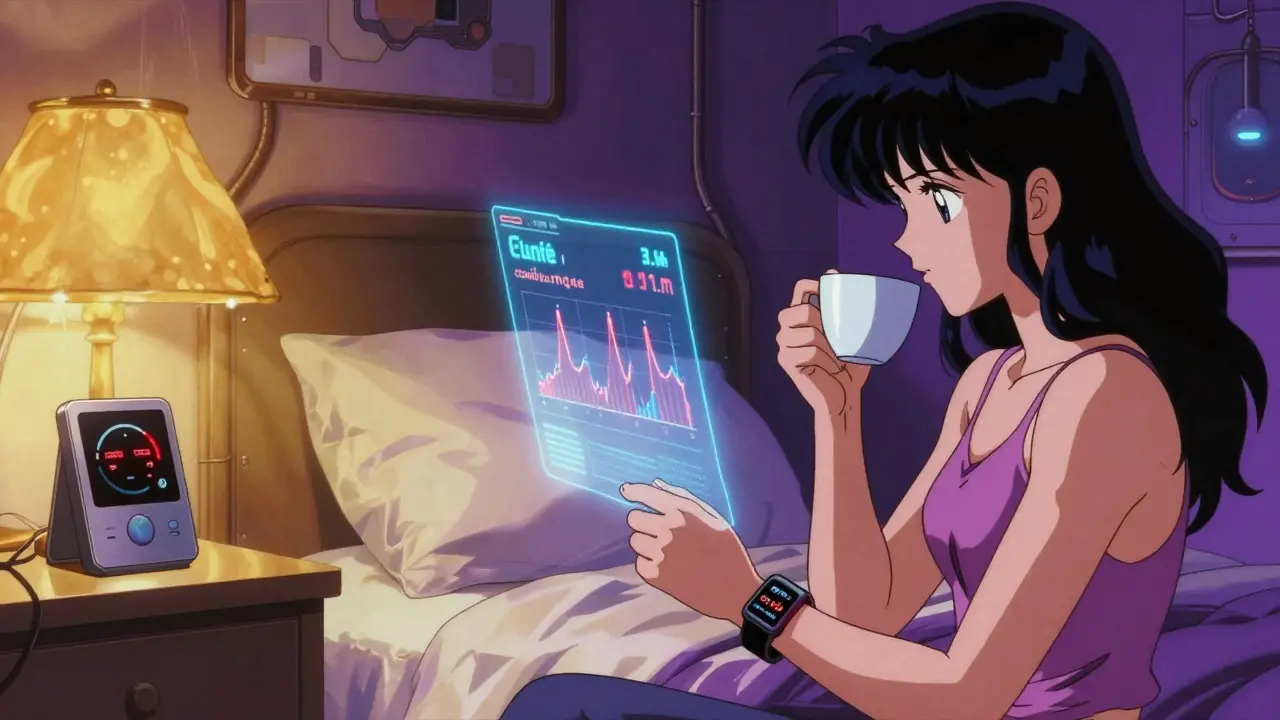
- Use your smartwatch. Oura Ring and Fitbit now track caffeine and sleep. If your sleep score drops after afternoon coffee, it’s not coincidence.
Some people swear by decaf. But be careful - decaf coffee still has 2-5 mg of caffeine per cup. If you’re a slow metabolizer, that adds up. Four decaf lattes in the afternoon? That’s 20 mg. Still enough to disrupt sleep for some.
The Future: Personalized Cutoffs Are Coming
One-size-fits-all advice is fading. In January 2025, the American Academy of Sleep Medicine announced it will update its guidelines to include beverage-specific cutoff times - not just “avoid caffeine late.”
Companies like 23andMe now offer caffeine metabolism reports for $199. A 2024 study showed machine learning models using your genes, age, and sleep history can predict your ideal cutoff time with 89% accuracy. That’s 22% better than the current 8-hour rule.
Smart home tech is catching up too. Philips SmartSleep is testing systems that adjust room temperature and lighting based on when you consumed caffeine. Imagine your lights dimming automatically because your wearable detected your 3 p.m. espresso.
But here’s the problem: only 28% of adults even know about the 8-hour cutoff rule. Most still think “no coffee after dinner” is enough. That’s like saying “don’t drive drunk after midnight” - ignoring the fact that alcohol lingers for hours.
What to Do Right Now
You don’t need a DNA test. You don’t need a fancy app. You just need to try this:
- Stop all caffeine after 2 p.m. for 7 days.
- Write down how you feel in the morning - energy, mood, focus.
- Then, go back to your old habit for 3 days.
- Compare.
Chances are, you’ll notice a difference. Better sleep isn’t about drinking less. It’s about drinking at the right time. And if you’re serious about sleep, caffeine isn’t something you cut out - it’s something you schedule.
It’s not about being perfect. It’s about being aware. One cup too late can cost you an hour of rest. And over time, that adds up to weeks of lost sleep every year.
So ask yourself: Is that last latte worth it?
What time should I stop drinking coffee to sleep better?
For most people, stop caffeine by 2 p.m. if you go to bed around 11 p.m. That gives your body 9 hours to clear a standard cup of coffee (107 mg). If you’re sensitive or over 40, aim for 1 p.m. or earlier. The 8.8-hour rule is based on caffeine’s half-life and real-world sleep studies - not guesswork.
Can I drink tea after 4 p.m.?
Black tea has about half the caffeine of coffee and contains L-theanine, which helps calm the nervous system. For most people, a cup of black tea at 5 p.m. won’t ruin sleep. Green tea still has caffeine - avoid it after 3 p.m. Herbal teas like chamomile, peppermint, or rooibos have zero caffeine and are safe any time.
Does decaf coffee affect sleep?
Decaf coffee still has 2-5 mg of caffeine per cup. If you drink one or two, it’s unlikely to matter. But if you have four decaf lattes after lunch, that’s 20-40 mg - enough to disrupt sleep for slow metabolizers or sensitive individuals. If you’re struggling with sleep, try switching to herbal tea after 2 p.m. to be sure.
Why do I sleep fine after coffee but still feel tired?
You might fall asleep, but caffeine reduces deep sleep and sleep efficiency. That means your brain never fully recovers. You’re spending more time in light sleep, waking up more often, and getting less restorative rest. You feel tired not because you didn’t sleep - but because you didn’t sleep well.
Is caffeine worse for older adults?
Yes. Studies show adults between 41 and 58 are more sensitive to caffeine’s effects on sleep latency, duration, and efficiency than younger adults. Metabolism slows with age, so caffeine stays in your system longer. If you’re over 40 and sleep has gotten worse, caffeine timing is likely a bigger factor than you think.
Can I use caffeine to stay awake during the day?
Yes - but strategically. Have your coffee in the morning, ideally between 8 and 10 a.m., when cortisol (your natural wake-up hormone) dips. That’s when caffeine works best. Avoid it after 2 p.m. to protect your sleep. Using caffeine to compensate for poor sleep creates a cycle: less sleep → more caffeine → worse sleep. Break the loop by timing it right.
Nicole K.
December 29, 2025 AT 14:02I don't care what science says, I drink coffee at 8 p.m. and sleep like a baby. You people are just scared of caffeine. It's not the coffee, it's your weak willpower.
Fabian Riewe
December 31, 2025 AT 08:41Hey, this is actually super helpful! I always thought I was fine with afternoon coffee until I started tracking my sleep with my OURA ring. Big difference after switching to 2 p.m. cutoff. No more 3 a.m. wake-ups. Thanks for breaking it down so clearly 😊
Amy Cannon
January 1, 2026 AT 22:12It is rather fascinatin' how modern society has become so reliant on this little bean-derived stimulant, don't you think? I mean, the entire corporate workday is built around caffeine consumption patterns, and yet we rarely pause to consider the neurochemical implications. The human body evolved over millennia without espresso machines, and now we're surprised when our cortisol levels go haywire? I'm not sayin' we should go back to candlelight, but perhaps we should reconsider our relationship with this substance. Also, typo: 'lattes' not 'lattes.' 😅
Himanshu Singh
January 3, 2026 AT 18:50Wow this is realy useful! I was drinking pre-workout at 7am and wonder why i was wake at 11pm. Now i know. Gonna try 2pm rule. Thanks!
Jasmine Yule
January 4, 2026 AT 17:26Ugh. I’ve been saying this for years. People act like caffeine is harmless. It’s not. It’s a drug. And if you’re sleeping ‘fine’ after 4 p.m. coffee, you’re just lying to yourself. I used to be one of you. Then I tried going cold turkey for a week. My sleep score went from 72 to 89. I cried. It was that dramatic. 🥲
Lisa Dore
January 4, 2026 AT 20:57This is such a gentle, practical guide! I love how you included tea options and decaf caveats. My mom’s been drinking 5 decaf lattes a day since 2018 and thinks she’s ‘fine.’ I’m sending her this. Maybe it’ll help her finally sleep through the night. You’re doing great work here 💪☕
Sharleen Luciano
January 5, 2026 AT 03:41Only people who can't discipline themselves need a 2 p.m. cutoff. Real adults drink coffee whenever they want. If you're waking up at 3 a.m. because of caffeine, maybe your problem isn't the coffee - it's that you're a sleep-deprived, overstimulated mess who needs to get their life together. Also, your ‘science’ is just correlation. You didn’t control for screen time.
Jim Rice
January 5, 2026 AT 16:508.8 hours? That’s ridiculous. My half-life is 3 hours. I drink espresso at 5 p.m. and fall asleep at 9. You’re overcomplicating this. Also, your ‘studies’ are funded by sleep app companies. Wake up.
Henriette Barrows
January 6, 2026 AT 15:31I’ve been doing the 2 p.m. rule for 3 weeks now and honestly? My brain feels clearer. Not just more awake - clearer. Like the fog lifted. I didn’t even realize how fuzzy my focus had been until it was gone. Also, I tried black tea at 5 p.m. and it was perfect. No jitters, no sleep issues. Thank you for making me feel less guilty about my tea habit 😊
Alex Ronald
January 7, 2026 AT 18:03One thing missing here: hydration. Caffeine is a diuretic, and dehydration worsens sleep quality. Even if you cut caffeine at 2 p.m., if you’re not drinking enough water all day, you’re still sabotaging your sleep. I started drinking 2L of water daily + 2 p.m. cutoff. Sleep efficiency jumped from 78% to 91%. It’s not just caffeine - it’s the combo.
Teresa Rodriguez leon
January 8, 2026 AT 02:03I’ve been drinking coffee since I was 16. I’m 47 now. I’ve had insomnia for 12 years. I’ve seen therapists, taken melatonin, tried magnesium, yoga, weighted blankets. Nothing worked. Then I stopped coffee after 2 p.m. Last night? I slept 7 hours straight. For the first time in a decade. I don’t know what to say. I’m just… numb.
Manan Pandya
January 9, 2026 AT 06:50This is a well-researched piece. I appreciate the inclusion of genetic factors and beverage-specific half-lives. Many people overlook that caffeine metabolism varies significantly. I’ve been advising my clients to use wearable data alongside caffeine logs - it’s a game-changer. Also, decaf isn’t harmless for slow metabolizers. Two cups = 10 mg. That’s enough to delay REM onset. Solid advice.
Aliza Efraimov
January 10, 2026 AT 10:33My dad’s 68. He drinks espresso at 6 p.m. and says he’s fine. I showed him your 8.8-hour rule. He laughed. Then he checked his Oura ring data. He’s been losing 52 minutes of deep sleep every night. He just switched to herbal tea. He’s now sleeping like a 25-year-old. I cried. This isn’t just about coffee - it’s about dignity. We owe our older selves better sleep.
Nisha Marwaha
January 10, 2026 AT 22:44From a neuropharmacological standpoint, the adenosine receptor antagonism mechanism is well-documented, but the circadian modulation of CYP1A2 expression introduces significant inter-individual variability. The 8.8-hour threshold is statistically significant (p < 0.01) in cohort studies, but real-world adherence requires behavioral nudges - not just education. I’d recommend integrating this into workplace wellness programs as a chronobiological intervention. Also, note that the half-life increases with BMI > 30. Just saying.
Linn Leona K
January 11, 2026 AT 14:30So if I drink a latte at 1 p.m., I’m good? 😅