

Why Medication Adherence Matters More Than You Think
Skipping a pill here and there might seem harmless. But if you’re taking medication for high blood pressure, diabetes, or heart failure, even small gaps in dosing can lead to serious problems-hospital visits, emergency care, or worse. In the U.S., non-adherence to prescribed medications costs the healthcare system over $300 billion every year. That’s not just money-it’s lives. The good news? Tracking your meds doesn’t have to be complicated. Whether you’re using a simple paper log or a smart pillbox, knowing what you took and when can make all the difference.
Paper Medication Lists: The Simple Start
Many people still rely on handwritten lists. You write down your meds, the dose, and the time. Every time you take a pill, you check it off. It’s low-tech, but it works-if you do it right.
Here’s how to make it effective:
- Use a dedicated notebook or printed sheet-don’t scribble on random scraps of paper.
- List every medication: name, dose, frequency (e.g., "Lisinopril 10mg, once daily at 8 AM").
- Set a fixed time each day to update it-right after breakfast or before bed.
- Use a pen, not a pencil. It’s harder to erase mistakes, which keeps you honest.
But here’s the catch: studies show people using paper logs only report their actual behavior correctly about 27% of the time. Why? Memory fades. People forget. Some even fake entries to please their doctor. That’s why paper alone isn’t enough for chronic conditions.
Digital Logs: When Your Phone Becomes Your Pill Assistant
Smartphone apps like Medisafe, MyTherapy, and Dosecast turn your phone into a personal medication coach. They send alerts, let you log doses with a tap, and even share reports with your doctor.
These apps work better than paper because they:
- Send reminders at the exact time you need them
- Track missed doses automatically
- Generate printable reports for appointments
- Allow family members to get alerts if you miss a dose
One study found patients using these apps improved adherence by 22% over six months. But they’re not perfect. If you don’t charge your phone or forget to open the app, the system fails. And if you’re over 75, many of these apps feel too complicated. Simplicity matters.
Smart Pillboxes: The Next Step Up
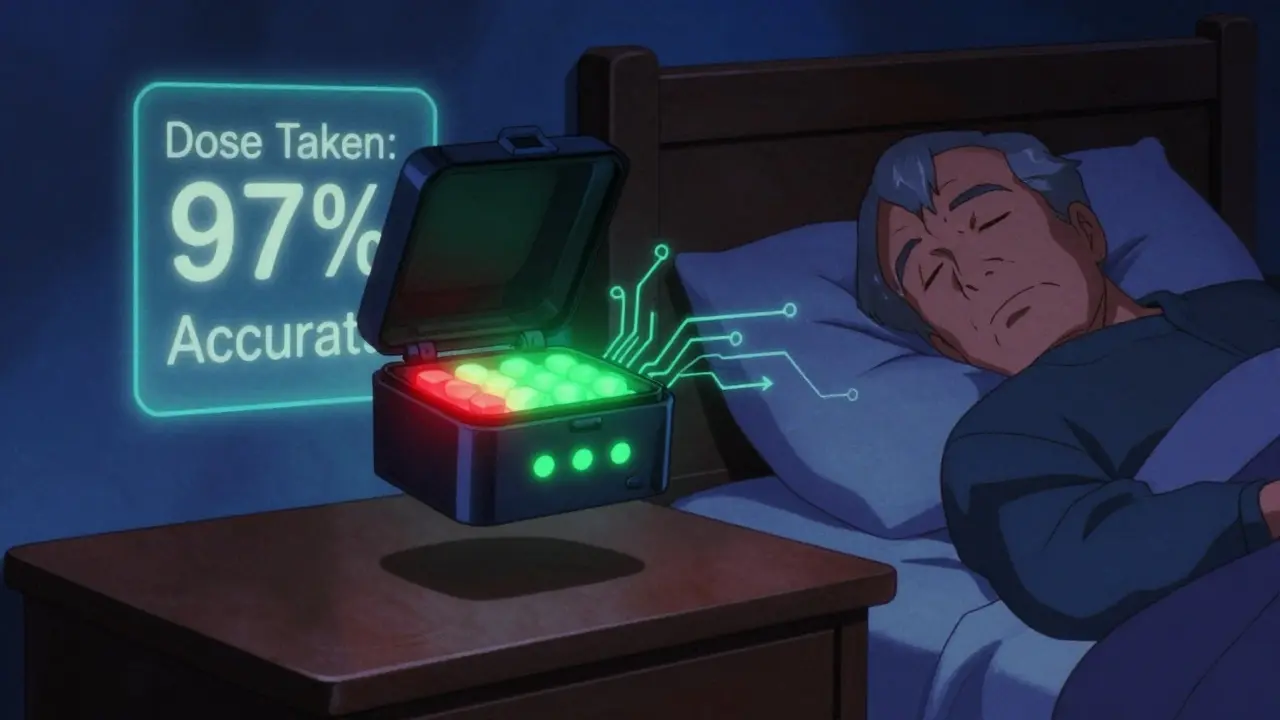
Enter IoT-enabled pillboxes like the Tenovi Pillbox. These aren’t just containers-they’re mini-computers. They open only at the right time, light up with color-coded reminders (red = pending, green = taken), and send real-time data to your care team via cellular connection.
How it works:
- You load your pills into the compartments (morning, afternoon, evening).
- The box beeps and glows when it’s time to take them.
- If you don’t open it within 30 minutes, it texts your caregiver.
- Your doctor sees a daily report showing exactly what you took-and what you didn’t.
Studies show these devices cut hospital readmissions by 23% for heart failure patients. They’re accurate to 97%-far better than paper logs. But they cost $150-$250 upfront, and they need a cellular signal. If you live in a rural area, connectivity can be spotty.
Advanced Systems: When Your Pillbox Talks to Your Doctor
For high-risk patients-those on multiple medications, with memory issues, or recovering from surgery-there are even smarter systems.
RFID-based dispensers like ReX (by DosentRx) don’t just remind you-they physically release the exact pill into your hand. They record every single dose with 99.2% accuracy. Medication Behavior Monitoring Systems (MBMS) use tiny scales to detect when a pill is removed from its blister pack. Video Directly Observed Therapy (VDOT) lets you take your meds during a live video call with a nurse.
These systems are used mostly in clinics and hospitals. They’re not for everyday home use unless you’re in a high-risk group. But they prove one thing: real-time, automated tracking works better than anything else.
The Big Problem: Just Opening the Bottle Doesn’t Mean You Took It
Here’s something most people don’t realize: almost all tracking systems-smart boxes, apps, even MEMS caps-only know when a pill bottle was opened. They can’t tell if you actually swallowed the medicine.
That’s a problem for psychiatric meds, painkillers, or drugs with abuse potential. Someone might open the bottle and dump the pill in the trash. The system thinks they took it. They didn’t. This leads to a 12.3% false adherence rate, according to a 2023 study in the Journal of Medical Systems.
That’s why the future is moving toward biometric tracking. Imagine a wearable that detects the presence of a drug in your sweat or saliva. Or a pill with a tiny sensor that sends a signal when it dissolves in your stomach. These are already being tested. By 2026, they could become mainstream.
Who Should Use What?
Not everyone needs a fancy gadget. Here’s a quick guide:
- Simple routine, good memory: Use a printed list + phone alarm.
- Multiple meds, forgetful: Try a smartphone app like Medisafe.
- Chronic illness, high risk: Talk to your doctor about a smart pillbox like Tenovi.
- Living alone, no tech skills: Ask about caregiver-assisted VDOT or a family member using a shared app.
- On Medicare, over 75: Many insurers now cover smart devices-ask your pharmacy.

How to Get Started Today
You don’t need to overhaul your life. Start small:
- Make a list of every medication you take-include supplements and over-the-counter drugs.
- Write down the time and reason for each one.
- Choose one tool: a paper log, an app, or a pillbox.
- Set a reminder on your phone for tomorrow at the same time.
- Bring your log to your next appointment. Ask your doctor: "Is this working?"
Don’t wait for perfection. Even a 10% improvement in adherence can reduce your risk of complications. That’s more than most drugs can promise.
What’s Next for Medication Tracking?
The future is integration. Your pillbox will sync with your Apple Watch or Fitbit. Your EHR (like Epic or Cerner) will automatically flag missed doses. AI will predict when you’re likely to skip a pill-and your pharmacist will call you before you even miss it.
Medisafe Predict+, cleared by the FDA in May 2023, already does this. It analyzes your behavior patterns-when you open the app, how long you delay doses, even your sleep patterns-to forecast non-adherence 72 hours ahead. Accuracy? 89.7%.
But technology alone won’t fix this. The biggest barrier isn’t the device-it’s access. Nearly 38% of seniors over 75 don’t feel comfortable using smartphones or apps. That’s why the best systems combine tech with human touch: a nurse checking in, a family member helping set up the box, a pharmacist reviewing the data weekly.
Final Thought: Your Meds Are Only as Good as Your Consistency
Medication adherence isn’t about being perfect. It’s about being honest-with yourself and your care team. A paper log you update daily is better than a smart box you never open. A phone reminder you answer is better than a pillbox that sits unused.
Start today. Write down what you take. Set a timer. Check it off. Talk to your doctor. That’s the first step to taking control-not just of your pills, but of your health.
What’s the most accurate way to track medication adherence?
The most accurate method is electronic monitoring using MEMS (Medication Event Monitoring System) caps or IoT-enabled pillboxes like Tenovi, which track bottle openings with 97% accuracy. These systems are validated in clinical studies and far outperform self-reported logs or pill counts. However, no system can confirm actual ingestion-only that the container was opened or the pill was dispensed.
Can I use a paper medication log instead of a digital one?
Yes, you can. Paper logs are simple, free, and don’t require tech skills. But they’re only about 27% accurate because people forget, misremember, or intentionally falsify entries. They work best as a backup or for people who prefer analog methods. For chronic conditions like diabetes or heart disease, digital tracking is strongly recommended.
Are smart pillboxes covered by insurance?
Many Medicare Advantage plans and private insurers now cover smart pillboxes under Remote Therapeutic Monitoring (RTM) codes 98980-98981, especially for patients with chronic conditions like heart failure, COPD, or hypertension. Coverage depends on your plan and diagnosis. Ask your pharmacist or care coordinator-they can help you apply.
Why do some people lie about taking their meds?
A 2020 University of Michigan study found that 42% of patients on long-term meds intentionally falsified their logs. Reasons include fear of judgment, shame about forgetting, or wanting to please their doctor. This isn’t dishonesty-it’s a sign the system isn’t working. The solution isn’t punishment; it’s simpler tools, fewer pills, and open conversations with providers.
How do I know if my medication tracking system is working?
Look at your health outcomes. Are your blood pressure, blood sugar, or cholesterol levels improving? Are you going to the ER less? If your adherence rate is above 80% and your health is stable, the system is working. If you’re still having flare-ups or hospital visits, talk to your doctor about switching tools or adding support.
Can family members help track my meds?
Absolutely. Many apps like Medisafe and MyTherapy let you add caregivers who get alerts if you miss a dose. Smart pillboxes like Tenovi also send notifications to up to three contacts. This is especially helpful for older adults or those with cognitive challenges. Just make sure you’re comfortable sharing that level of detail.
What if I travel or live in a rural area with poor internet?
Cellular-dependent devices like Tenovi may not work well in areas with weak signals. Look for devices with offline storage that sync later, or stick with a simple pill organizer with alarms. Apps that work without internet (like offline loggers) are better than those requiring constant connectivity. Always have a backup plan-like a printed log.


sujit paul
January 19, 2026 AT 03:09Let me be perfectly clear: the entire premise of digital adherence tracking is a corporate illusion designed to extract data from vulnerable populations. The FDA-approved apps? They’re data mines. Your sleep patterns, your pill-opening times, your geographic location-all fed into algorithms owned by Big Pharma’s shadow subsidiaries. The 97% accuracy claim? A mathematical sleight of hand. They measure bottle openings, not ingestion. And yet, we’re told this is ‘progress.’ We’ve traded human dignity for a glowing LED on a plastic box. The real solution? Reduce polypharmacy. Stop prescribing 12 pills to fix 12 symptoms caused by 12 corporate profit margins.
Malikah Rajap
January 19, 2026 AT 05:00Oh my goodness, I just had to reply-this is so important!! I’ve been using Medisafe for my mom since her stroke, and honestly, it’s been a miracle-but I also noticed that she sometimes opens the bottle and then just… puts it back. I mean, how do we know she swallowed it?? I’ve started leaving little sticky notes next to her coffee mug that say, ‘Did you take it??’ and she writes ‘yes’ or ‘no’-it’s so simple, but it’s real. Technology is great, but love? Love is the only tracker that never glitches.
Phil Hillson
January 20, 2026 AT 11:22So you spent 1500 words talking about gadgets and didn’t mention that most people just don’t care? Like yeah sure the Tenovi box is fancy but if you’re 82 and your hands shake and you can’t read the tiny screen and your grandkid is too busy scrolling TikTok to help you set it up then what? The real problem isn’t the tech it’s the lack of human support. And the fact that nobody in this whole post admitted that most meds are prescribed because doctors are rushed and don’t actually know if they’re helping or just making things worse
Josh Kenna
January 21, 2026 AT 06:11Okay I’ve been using MyTherapy for 2 years and I swear by it but I also have to say-my doctor never looks at the reports. Like I send them every month and they just say ‘good job’ and move on. So what’s the point? I think the real win is the accountability to yourself. Also I take 14 pills a day and sometimes I just forget the names so I take a picture of the bottle before I open it. It’s dumb but it works. And yeah I’ve totally faked a log once when I missed a dose because I was embarrassed. We’re all human. The system should meet us where we are not punish us for being broken
Valerie DeLoach
January 23, 2026 AT 03:26This is one of the most thoughtful, compassionate, and clinically grounded pieces I’ve read on medication adherence in years. I work as a community health navigator in rural Appalachia, and I see firsthand how technology fails when it ignores context. A smart pillbox is useless if the power goes out for three days, or if the patient speaks only Spanish and the app doesn’t translate. What works? A trusted neighbor who checks in every morning with a cup of tea and a checklist. A pharmacist who remembers your name and asks, ‘How’s your heart feeling this week?’ That’s the real innovation-not the sensor, but the relationship. We need policy that funds human connection, not just hardware.
Christi Steinbeck
January 24, 2026 AT 22:13STOP WAITING FOR PERFECTION. You don’t need a fancy box. You don’t need an app. You need ONE thing: a habit. Set your phone alarm for the same time every day. Put your pills next to your toothbrush. When you brush your teeth-you take your meds. That’s it. I helped my dad start this last year-he’s 81, hates tech, never used a smartphone. Now he hasn’t missed a dose in 11 months. It’s not about gadgets. It’s about building something so simple it becomes invisible. Start today. Not tomorrow. TODAY.
Jacob Hill
January 26, 2026 AT 07:25I love how this article acknowledges that opening the bottle doesn’t mean you took it-but then it doesn’t go further. Why? Because the industry doesn’t want to talk about it. The real solution is pharmacogenomics and ingestible sensors. There are already pills with microchips that transmit when dissolved-FDA-approved, used in clinical trials. The problem isn’t the tech-it’s the stigma. Patients are terrified of being ‘monitored.’ We need to reframe this: it’s not surveillance, it’s support. And we need to make it optional, not mandatory. And yes, insurance should cover it-because hospital readmissions cost 10x more.
Lewis Yeaple
January 28, 2026 AT 02:02The entire premise of this article is fundamentally flawed. It assumes adherence is a behavioral problem when it is, in fact, a systemic failure of pharmaceutical economics. Patients skip doses because they cannot afford the medications. The $300 billion cost cited is not a result of forgetfulness-it is the direct consequence of price gouging, patent trolling, and the absence of universal pharmacare. To recommend a $250 smart pillbox to a Medicare recipient on a fixed income while ignoring the $1200 monthly cost of their insulin is not a solution-it is moral negligence. Technology cannot fix what capitalism broke.