

Vitamin K Intake Consistency Calculator
Your Vitamin K Tracker
This tool helps you monitor your daily vitamin K intake to maintain stable INR levels while taking warfarin. The recommended daily range is 60-120 µg (micrograms). Consistency is more important than restriction.
Current Daily Intake
No food added yet
Intake Consistency
How It Works
Step 1: Select a food item from the dropdown and enter how much you're eating.
Step 2: Click "Add to Day" to track your intake. Your total will update automatically.
Step 3: After entering multiple days, the tool will show your consistency percentage.
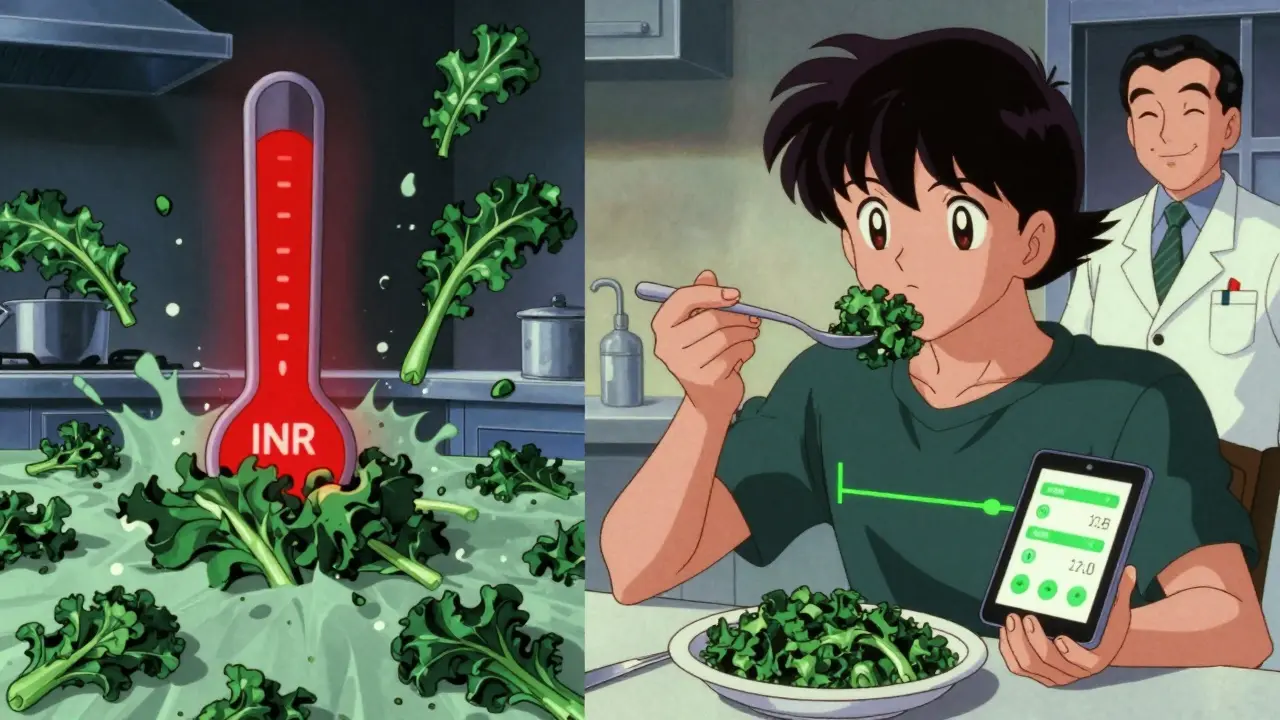
When you’re on warfarin, your life doesn’t just revolve around taking a pill every day. It’s about what you eat-and how consistently you eat it. Many people assume they need to avoid greens like spinach and kale entirely. That’s not true. In fact, cutting out these foods can make your INR more unstable, not less. The real secret? Consistency. Not restriction.
Why Vitamin K Matters When You’re on Warfarin
Warfarin works by blocking a key enzyme called VKORC1. This enzyme helps recycle vitamin K so your body can make clotting factors. Without enough active vitamin K, those factors don’t form properly, and your blood thins. But here’s the twist: vitamin K doesn’t disappear from your body. It’s always there, cycling in and out. If you eat a huge amount one day and almost none the next, your body’s vitamin K levels swing wildly. That causes your INR to bounce up and down. The INR (International Normalized Ratio) is the number your doctor watches to know if your blood is thinning just right. Too low? Risk of clots. Too high? Risk of bleeding. The sweet spot is usually between 2.0 and 3.0. For some people-like those with mechanical heart valves-it’s higher, around 2.5 to 3.5. But no matter your target, your INR stays steady only if your vitamin K intake stays steady.The Myth of Restricting Vitamin K
For years, doctors told patients on warfarin to avoid vitamin K-rich foods. That advice has changed. Big time. A 2021 guideline from the American College of Chest Physicians (CHEST) says outright: “Dietary vitamin K restriction is not recommended and may be harmful.” Why? Because cutting back on vitamin K doesn’t make INR more stable-it makes it worse. When people restrict greens, their bodies start to run low on vitamin K. That causes a buildup of undercarboxylated proteins, which makes clotting factors less responsive to warfarin. The result? Wild INR swings. A study in Blood (2015) showed that patients who added 150 µg of vitamin K daily-instead of avoiding it-saw their time in therapeutic range jump from 58.4% to 65.6%. That’s a real improvement. Another study found that patients who kept their vitamin K intake within ±20% each day improved their time in range by nearly 15 percentage points. That’s not a small win. That’s the difference between stable care and emergency room visits.How Much Vitamin K Is Too Much-or Too Little?
The recommended daily amount for adults is 90 µg for women and 120 µg for men. But most Americans already hit those numbers. The average woman eats about 93 µg a day. The average man eats 122 µg. You’re probably not deficient. What matters isn’t how much you eat overall-it’s how consistent you are. One cup of cooked spinach has 889 µg. One cup of raw kale has 547 µg. That’s a lot. But if you eat one cup of spinach every Tuesday and Thursday, your body adapts. Your INR stabilizes. If you eat spinach on Monday, then nothing for five days, then a whole bunch on Saturday? Your INR will spike and crash. The Anticoagulation Forum recommends keeping your daily intake between 60 and 120 µg. That’s not a limit-it’s a target range. You can get there with a few smart choices:- 1 scrambled egg: 20 µg
- ½ cup cooked broccoli: 102 µg
- 3 oz chicken breast: 2 µg
- 1 cup mixed greens (kale, spinach, arugula): 150-300 µg (depending on mix)
- 1 cup cooked Brussels sprouts: 219 µg
- 1 tablespoon soybean oil: 25 µg
Real People, Real Results
Reddit user u/WarfarinWarrior posted in 2023: “My INR was all over the place until my pharmacist gave me a vitamin K tracking sheet. Now I eat exactly one cup of mixed greens every Tuesday and Thursday. My time in range jumped from 45% to 78%.” That’s not luck. That’s structure. A survey by the National Blood Clot Alliance found that 57% of emergency visits related to warfarin were due to inconsistent diet. That’s more than missed doses, more than alcohol, more than drug interactions. It’s the food. Meanwhile, patients who worked with certified anticoagulation pharmacists-getting personalized meal plans and tracking tools-hit 82% time in therapeutic range. That’s far above the national average of 63%.Tools That Actually Help
Tracking vitamin K isn’t guesswork. There are tools built for this. The Vitamin K Consistency Calculator from the University of North Carolina helps you plan meals to stay within ±15% variation. Apps like Warframate (iOS and Android) let you scan foods or search a database of 1,200+ items with USDA-backed data. These aren’t fancy gimmicks. They’re clinical tools used in hospitals. One key tip: use measuring cups. A 2022 study found that people who estimated portion sizes visually had 45% more variation in vitamin K intake than those who measured. A “handful” of spinach isn’t the same as a cup. One cup of raw spinach is about 145 µg. Two cups? 290 µg. That’s a 145 µg swing in one meal. The American Society of Health-System Pharmacists says: “Track your intake for the first 4-6 weeks. Use a food diary. Don’t change your diet without talking to your pharmacist.”
Genetics and Individual Differences
Not everyone reacts the same way. Some people are naturally more sensitive to vitamin K because of their genes. Variants in the CYP2C9 and VKORC1 genes affect how fast your body breaks down warfarin and how strongly it responds to vitamin K. People with certain variants may need tighter control-keeping intake within ±10% instead of ±20%. That’s why some patients need more frequent INR checks. Dr. Jack Ansell points out that these genetic differences explain why 15-30% of INR variability still can’t be predicted by diet or dose alone. But even if you’re genetically sensitive, the solution isn’t to avoid greens. It’s to know your pattern and stick to it.What You Should Do Today
You don’t need to overhaul your diet. You need to make one change: be predictable.- Don’t cut out leafy greens. Keep eating them.
- Choose 2-3 vitamin K-rich foods you like. Eat them the same amount, on the same days.
- Use a measuring cup for greens, not your hand.
- Track your intake for four weeks. Use an app or a notebook.
- Before you change your diet-whether you’re adding kale or skipping it-talk to your pharmacist.
- Don’t start vitamin K supplements without medical advice. Even 150 µg a day can shift your INR.
The Bottom Line
Warfarin isn’t about fear. It’s about routine. You don’t need to live on white rice and chicken breast. You can still enjoy your greens, your broccoli, your eggs. But you need to do it the same way, every day. That’s what keeps your INR steady. That’s what keeps you out of the hospital. That’s what keeps you safe. Research shows that consistent vitamin K intake cuts your risk of bleeding or clotting events by up to 15% for every 10% increase in time in therapeutic range. That’s not a small benefit. It’s life-changing. Your body doesn’t care if you ate spinach yesterday. It only cares if you eat it again tomorrow. Make it predictable. Your INR will thank you.Can I eat spinach if I’m on warfarin?
Yes, you can-and you should, if you eat it consistently. The problem isn’t spinach itself. It’s eating a large amount one day and none for a week. Aim to eat the same portion (like one cup) on the same days each week. This helps your body adapt and keeps your INR stable.
Should I avoid all green vegetables on warfarin?
No. Avoiding green vegetables can actually make your INR less stable. Studies show that restricting vitamin K leads to biochemical changes that increase day-to-day INR variability. The current standard of care is to eat vitamin K-rich foods regularly, but consistently-not to eliminate them.
How much vitamin K should I eat per day?
Aim for 60-120 micrograms (µg) per day, spread evenly. That’s about one cup of raw kale or half a cup of cooked broccoli. Most Americans already meet this range. The key isn’t the total amount-it’s keeping it consistent from day to day.
Can I take a vitamin K supplement while on warfarin?
Only under medical supervision. Even a 150 µg daily supplement can significantly change your INR. A 2015 study showed it improved time in range-but only because it was carefully controlled. Self-prescribing supplements can be dangerous. Always talk to your pharmacist or doctor first.
Why does my INR keep changing even though I take my pill on time?
Diet is one of the biggest reasons. Even if you take warfarin perfectly, inconsistent vitamin K intake can cause your INR to swing. Other factors include alcohol, new medications, illness, or genetics-but diet is the most common and easiest to fix. Tracking your food intake for 4-6 weeks often reveals the pattern.
Do I need to use an app to track vitamin K?
Not required, but highly recommended. Apps like Warframate use USDA data to show vitamin K content in over 1,200 foods. They’re far more accurate than guessing. Studies show people who estimate portions visually have 45% more variability in intake. Using a tool reduces guesswork and improves control.
Can my genetics affect how vitamin K impacts my INR?
Yes. Variants in the VKORC1 and CYP2C9 genes make some people more sensitive to vitamin K changes. If you have these variants, you may need tighter consistency-keeping intake within ±10% instead of ±20%. Genetic testing isn’t routine, but if your INR stays unstable despite good diet control, ask your doctor about it.
What if I want to start eating more greens?
Don’t suddenly increase your intake. If you want to add more greens, do it slowly and track your INR. For example, if you usually eat one cup of kale twice a week, try adding half a cup on one of those days. Wait a week, check your INR, then adjust. Sudden changes can cause your dose to become too high or too low.


THANGAVEL PARASAKTHI
February 7, 2026 AT 15:59man i been on warfarin for 5 years now and this post hit different. i used to avoid spinach like it was poison until my pharmacist laughed at me and said "bro you’re eating it once a week and then binging on kale on weekends? no wonder your inr’s all over the place." now i eat 1 cup of mixed greens every tuesday and thursday. no apps, no tracking, just consistency. my time in range went from 48% to 76%. simple as that.
Frank Baumann
February 8, 2026 AT 01:46OH MY GOD. I CANNOT BELIEVE HOW MANY PEOPLE ARE STILL OUT THERE THINKING THEY NEED TO AVOID GREENS. I WAS ON WARFARIN FOR 3 YEARS BEFORE I FOUND OUT THIS SECRET. I WAS EATING SPINACH SALADS EVERY DAY AND MY INR WAS A DISASTER. THEN I STOPPED. I STOPPED EVERYTHING. I ATE WHITE RICE AND CHICKEN BREAST FOR SIX MONTHS. AND DO YOU KNOW WHAT HAPPENED? MY INR WENT EVEN MORE CRAZY. I HAD TO GO TO THE ER TWICE. THEN MY PHARMACIST SAID "FRANK, YOU’RE NOT A DIET PATIENT, YOU’RE A CONSISTENCY PATIENT." SO I WENT BACK TO THE SPINACH. SAME PORTION. SAME DAYS. NOW I’M AT 81%. THIS ISN’T JUST MEDICINE. THIS IS A LIFESTYLE REVOLUTION. WE NEED TO STOP SCARING PEOPLE. WE NEED TO TEACH THEM TO BE REGULAR, NOT SCARED.
Scott Conner
February 9, 2026 AT 10:54so i tried the 150ug daily vit k supplement after reading this. my inr went from 2.8 to 4.1 in 3 days. i panicked. called my dr. she said "you idiot, you’re not supposed to just take it without adjusting your warfarin dose." turns out the study mentioned only did it under strict monitoring. i’m back to eating my usual kale on tues/thurs. no supplements. no guesswork. just the same old routine. if you’re thinking of self-prescribing vit k, don’t. you’ll end up in the hospital.
Alex Ogle
February 10, 2026 AT 17:03i’ve been on warfarin for 12 years. i used to be the guy who’d eat a whole bag of spinach in one sitting then go cold turkey for two weeks. i didn’t think it mattered. turns out, my body was screaming. i had two minor bleeds. one in my eye. one in my knee. both because of diet swings. i started using warframate. measured everything. same greens, same time, same cup. now i’m at 84% time in range. it’s not glamorous. it’s not exciting. but it’s the difference between living and being on constant watch. if you’re reading this and you’re struggling - just be boring. be predictable. your future self will thank you.
Brandon Osborne
February 12, 2026 AT 16:06THIS IS WHY AMERICA IS FALLING APART. PEOPLE AREN’T TAKING RESPONSIBILITY. YOU CAN’T JUST EAT WHATEVER YOU WANT AND EXPECT YOUR BODY TO BE FINE. I’VE SEEN THIS A HUNDRED TIMES. PATIENTS THINK THEY’RE SMART. THEY THINK THEY CAN "MANAGE" IT. BUT NO. YOU NEED STRUCTURE. YOU NEED RULES. YOU NEED A PLAN. I’M A NURSE. I’VE SEEN PEOPLE DIE BECAUSE THEY THOUGHT A "HANDFUL" OF SPINACH WAS FINE. A HANDFUL? THAT’S NOT A MEASUREMENT. THAT’S A LUXURY. YOU DON’T GET TO PLAY ROULETTE WITH YOUR BLOOD. THIS ISN’T A GAME. IF YOU CAN’T FOLLOW A SIMPLE RULE - DON’T BE ON WARFARIN. GET A NEW HEART VALVE OR SOMETHING.
MANI V
February 12, 2026 AT 20:06you people are so naive. vitamin k is not the problem. the problem is that big pharma and the american diet industry want you to believe you can eat like a normal person. but the truth? your body is a fragile machine. you think spinach is harmless? what about the pesticides? the nitrates? the fact that most greens are grown with synthetic fertilizers that mess with your liver? and don’t even get me started on the fact that warfarin itself is a rat poison. they’re just making you dependent. if you really want to be safe - stop eating processed food, stop taking warfarin, and start juicing celery and garlic. natural medicine. real healing. but no, you’d rather trust your pharmacist. sad.
Susan Kwan
February 14, 2026 AT 15:25ohhh so now we’re all supposed to be little vitamin k accountants? next thing you know, we’ll need a permit to eat broccoli. honestly, if you need an app to eat a salad, maybe you shouldn’t be on warfarin. or maybe you should just get a DOAC. they’re not perfect, but at least you don’t need a food diary to go to the gym.
Random Guy
February 15, 2026 AT 22:03bro i just ate a whole bag of kale and then skipped it for 5 days. my inr went from 2.5 to 4.8. i thought i was cool. turns out i was a walking bleeding hazard. now i eat 1 cup of spinach every tuesday and thursday like some kind of robot. my pharmacist gave me a sticker. i framed it. this is my life now. no drama. no fun. just consistency. i miss pizza.
Ryan Vargas
February 17, 2026 AT 20:58the real issue here isn’t vitamin k. it’s the epistemological collapse of modern medicine. we’ve replaced holistic understanding with quantifiable metrics - the INR as a god, the app as a priest. but blood clotting isn’t a math problem. it’s a biological dance between genetics, environment, and ancestral metabolic patterns. the fact that we’ve reduced a complex physiological process to "eat the same amount of spinach on tuesdays" reveals a deeper pathology: we’ve outsourced our bodily wisdom to algorithms. what happens when the app crashes? when the server goes down? when the USDA database updates and your kale suddenly has 12% less k? we’re not managing warfarin - we’re becoming its slaves. the true cure isn’t consistency - it’s reconnection. with nature. with tradition. with the rhythms our bodies knew before the pill.
Jessica Klaar
February 19, 2026 AT 13:29i’m from a country where we eat greens every day - no measuring, no apps, just tradition. my grandmother ate spinach with every meal and lived to 92 on warfarin. she didn’t track. she just ate like she always had. maybe the real lesson isn’t about portion sizes - it’s about cultural rhythm. if your life is chaotic, maybe the problem isn’t the spinach. maybe it’s the stress. maybe it’s the rushed meals. maybe it’s the fact that you’re eating alone in front of a screen. consistency isn’t just about food. it’s about peace. and peace comes from routine, not spreadsheets.